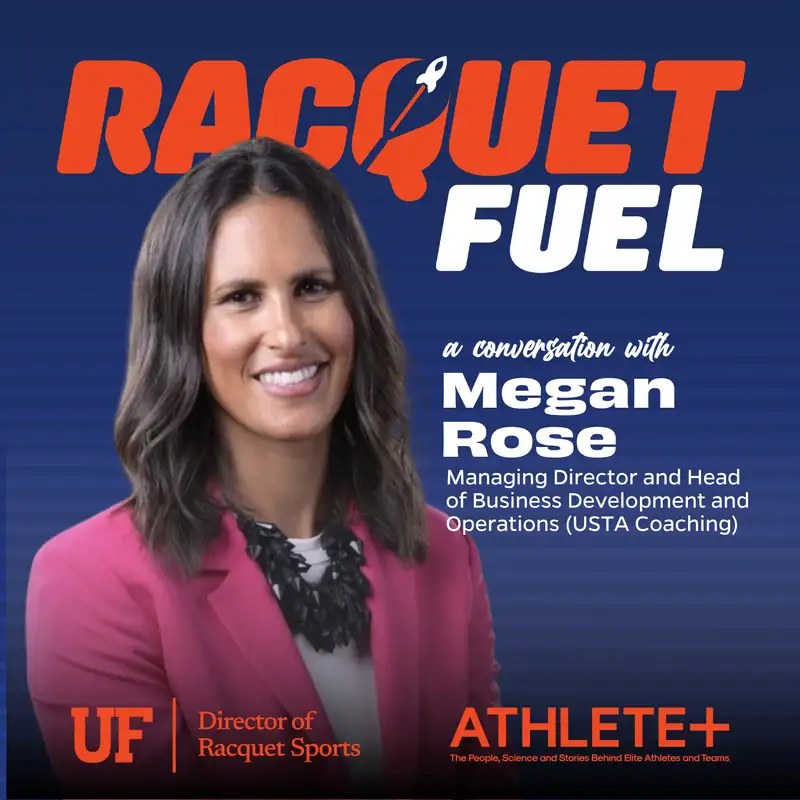
Coaching the Coaches: How USTA Is Powering Tennis Growth Nationwide
Welcome to Racquet Fuel, where we launch into great conversations and share powerful tools to help you become a stronger Racquet's leader. Your hosts are Kim Bastable, a former all American tennis player and now the director of professional rackets management at the University of Florida, and Simon Gale, the USTA senior director of racket sports development. Today on Racquet Fuel, Kim and Simon talked to Megan Rose. She's a former touring pro who has evolved into a strong business executive, forging many of the decisions that have gone into the launch of USTA coaching. Here are Kim and Simon.
Kim Bastable:Welcome to Racquet Fuel. I'm Kim Bastable. I'm here with Simon Gale. Simon, you're excited about this guest, and I am as well. Megan Rose, managing director of USTA Coaching.
Kim Bastable:And I think we've been fascinated watching USTA Coaching develop over the last year, or maybe Megan could tell us the exact time span. But she has led the vision and strategy and development of this coaching program. And, you've built a reputation, Megan, for driving innovation, collaboration, growth of the sport. Wow, Simon, this is great. Megan's gonna really share as as a woman leader, you know, how she dove into something that was really unknown and had to be built from scratch.
Simon Gale:Yeah. I mean, effectively, her and and and Craig Morris have it's a start up business. You know, this is a new a new division of the company, and I have the privilege of having a, call it, a dotted line up to USDA Coaching and spend time in that space. And I remember the first one of the first meetings I was in, it was one of Megan's first days, and you could just see that there was a lot going on. And it was new and it was being made up as we went along, and it was fascinating to think about.
Simon Gale:I wonder what's going through her head as she's trying to navigate this new role, and I think we all go through that. So getting some insight into that today is gonna be really interesting for for the people listening. So, Megan, welcome, and thank you for being part of the show today.
Megan Rose:Well, thank you so much for having me. I said before we recorded that I feel like I finally made it now that I get to be on on this podcast, so I'm excited for the conversation. And, yeah, it's been a it's been a pretty wild ride. I've been in this role since October officially of of twenty four, and before that, I at the UCA for about seven years working on the pro tennis side. So it's certainly been an exciting an exciting ride, and and we're just kinda getting started.
Simon Gale:So maybe you could start by explaining what the USDA's objective is with USDA Coaching.
Megan Rose:So USDA Coaching was really born out of the USDA strategy of 35,000,000 people by 2035. So this idea that in order to really increase participation of the sport in The United States, there's really kind of three levers that we need to pull. One of them being play format. So do we have enough opportunities for people to play however they wanna participate? Do we have enough facilities for people to play in?
Megan Rose:And then USCA Coaching was born out of the idea that we really need enough great coaches and people that are delivering the sport in a in a way and that people really wanna come back. I think we all know that if you have a bad experience, no matter what it is, whether it's on the tennis court, whether it's getting a haircut, you know, that if you have a bad first experience, you're probably not coming back. And so we wanna really with USTA coaching, we have a couple of really kind of key pillars that we're focused on. Now how can we get more coaches? And that's not just how do we get more coaches that are coaching forty hours a week, but how do we help encourage parents to get involved and be the first ones to introduce tennis to their kids?
Megan Rose:How do we get more young people, more diverse, more women into the career? How do we create more connection for coaches? So we know that even though coaches spend all their time around their clients, around players, they don't get a lot of time to spend with each other, so how do we help create that opportunity for connection? And then how do we really show that this is a great career? This is a great opportunity for people who wanna be outside, who wanna live a healthy lifestyle, who wanna be around people, who wanna really shape the experiences that people have.
Megan Rose:And so really looking at kind of all of these core pillars, we've really kind of built a business around being able to to achieve that.
Simon Gale:So you're the managing director of this monster ambitious program.
Kim Bastable:I
Simon Gale:am. Let's talk about your role. What what is it that you're specifically focused on as managing director?
Megan Rose:Yeah. So I have the pleasure of working with Craig Morris, who's our CEO, and my previous roles at the USTA really focused heavily around operations and execution of events and working with players. And so when this role became available, I think a part of the interest was that we did, to your point, Simon, we got to build something from scratch. And so I got really excited about that, and I think that that was one of the reasons why leadership thought that I would be a good person for this role is because I love executing on things. How do you take ideas?
Megan Rose:How do you take a lot of strategy and whiteboarding and people in a room, and how do you kind of determine a path and then and then get on that path to really achieve that. And so I would say, functionally, my role is to oversee membership. It's to oversee partnerships. How do we engage the sections? And then working really closely with our shared services on the digital product, our brand and marketing efforts, and also working with the membership team.
Megan Rose:So that's like functionally what I do. What I would really say is kind of as we've gotten through launch, I feel like I'm one of the coxswain on a boat that's kind of like helping to, you know, encourage people to all kind of row in the same direction, row at the same pace, and so it's been interesting to see how my role has evolved since when I started, and I was a real deer in headlights. I was like, oh my god, like, we how gonna do this? And how are we gonna do this in a short amount of time? And now it's exciting to see our team grow, and my opportunity to really help encourage and help everyone that's on the team, we have an incredible team, really allow them to be great at what they're great at, and encourage and inspire and provide them with the resources that they need in order to achieve the goals that kind of we've all set out to to accomplish together.
Kim Bastable:So you mentioned that you were intrigued by the idea of build from scratch. I find that interesting because that could be the thing that sends most people for the exits. The last thing they wanna do is build from scratch. They want the format already there, the functioning business already there. What other things do you think equipped you to be ready for this role besides that attitude?
Kim Bastable:What had you learned or developed maybe over your seven years in pro tennis or before? What what would you say?
Megan Rose:I think a couple things. One, I think ability to pivot. So in live events, you have a great plan, and, you know, what's that phrase, like, have a great plan until you get punched in the mouth or something like that? Like, maybe Mike Tyson said that. Like, it's great to have a plan, and then sometimes you realize that you have to pivot, and I think with USDA coaching, you know, Simon, you were in some of those initial meetings, kinda where we started and where we ended up were two very different places, and so having that kind of ability to I think it takes a certain amount of bravery to do that also, that like, hey, you know, yes, we we put some some time and some effort into this, but now it's just not the right way to go, and really kind of having the ability to kinda make that change and and kind of encourage everyone to be to get on board with that.
Megan Rose:I think being decisive has definitely helped. Again, going back to kind of experiencing live events, like, don't have a lot of time to sit around in a room and talk about, you know, certain things. Like, sometimes you just gotta be okay with with making the decision, and and I think also building consensus, I think that that's been a really huge part of this with USDA Coaching. This requires an incredible amount of collaboration, so not just internally within USDA, but we obviously, as you know, have 17 sections that we wanted to really feel like they were part of this process. We've wanted to make sure that coaches have really felt part of this process, that we are building this for something that they they need and that they want, and so, you know, Kim, you've been in a lot of those conversations.
Megan Rose:And then, you know, I also think I have a really high capacity. I think that that sometimes people think that as you kinda go up the ladder that maybe your your workload gets lighter. I can assure you that that is not the case, or at least that has not been my experience. And so I feel like I have a really high capacity to manage a lot of different components of a project or a lot of different meetings or expectations. And so I think kind of all of those things definitely helped prepare me, but I do think that USA Coaching has helped create additional skills that or or build on skills that maybe I wasn't using as often in my last role.
Megan Rose:And so I think that was also for me someone I consider myself to be really growth mindset. So just the opportunity to be able to, you know, to flex some other muscles has been really encouraging and definitely something that keeps me kind of super motivated every time I I come into the office because it's like, what are we gonna learn today? What do we need to understand today? What new decisions do we need to make today? So it's been it's been an incredible personal growth opportunity for me as well as professional.
Simon Gale:So in a high profile role like that and and other leadership roles you've had, you will have tough conversations, make difficult decisions. It just comes with the job, so to speak. So one of the skills that we've learned from, say, doctor Larry Lauer was the importance of reflection. So when you reflect back on your career in those moments, what's one of the hardest leadership lessons you've had to learn, and how has it impacted your approach since then?
Megan Rose:Yeah. I think it's a great question. I talk about the necessity of having difficult conversations a lot, because I actually think it's something that a lot of people just don't do. They think that if you shy away from a tough conversation, that that means it's gonna go away, and whether that's in your personal life or your professional life, I hate to tell you, but it's not. It's just gonna get worse because then it becomes walking on eggshells or it becomes you start to resent, and so as I was kind of moving into more leadership roles, I think that the one lesson I learned about that is, like, you really have to go in with the understanding that one of two things is gonna happen.
Megan Rose:Either one, there's gonna be a great outcome from it. So I've had experiences where someone is not being the teammate or being the contributor that we need on the team and had that direct conversation, and and that person turned it around completely, and it's one of my kind of proudest leadership moments, seeing the growth of this person after having that conversation. There's been other instances where you, that you have to understand that it's not gonna get better, and and that, but having that conversation kinda puts you at that crossroad, which is either someone has to decide that they're gonna be better, or they're gonna decide that this is not for them, or it's, you're gonna decide that it's not for you. And so I think you have to be really prepared for the outcome of that, but you also have to understand it's a necessary evil in order to continue to, like, achieve the goals of the overall department. And I think as someone who really I really pride myself on creating cultures where it's built off of me taking the time to understand each person that I work with as an individual, what makes them tick, you know, what what do they enjoy about their work, what motivates them, what doesn't motivate them, and and with that comes, like, I like to have a good time.
Megan Rose:I like to have people feel like I I appreciate them, and one of the hard parts about leadership is, like, not everyone's gonna like you, and that's and that's okay. But that doesn't mean ultimately my job, especially in this role, is to make USDA coaching successful, and part of that is going to be that not everyone is going to like me or my leadership style, but I have to know that ultimately that's the that's the goal, and how do I help facilitate an environment in which people can do that? And not everyone's gonna wanna do it in that same way. And so how do you have these kind of open and honest conversations to evaluate where everyone is and see where you have to take accountability. I mean, to to what Larry's saying, like, reflection.
Megan Rose:Okay. My leadership style in this instance is not the way that this person's gonna get the best I'm not gonna get the best out of this person in that way, so how do I need to adjust it in a way that doesn't jeopardize my value system in order to help them be successful? And other times, it's like, no. This is this is where we need to get, and this is how we need to do it. Craig and I talked about that a lot, actually.
Megan Rose:Like, at the beginning of USDA Coaching, there were times when it was time to drive. We have to hit this date. For the build of the website, like, we have to hit this date, and that's gonna require us to kind of, like, maybe take a step back from, like, nurturing a culture or nurturing an environment, but then once we hit that date, then it was like, okay, now we need to go back to nurturing the the culture and nurturing the environment, and that's not always easy, especially if you do want people to really enjoy working with you. That's there's gonna be days as a leader where, like, you're gonna have to make tough calls, and people are not gonna like it. And you have to be okay knowing that, like, you've been an honest communicator, a transparent communicator, and that people know that you're here for the right reasons, and then you're able to kinda work through that, I think.
Kim Bastable:That's a pretty fascinating answer. I really love that you speak to the idea of what I would almost call periodization. You've got some periods where you're pushing, charging hard, and then other times where you have a little bit of air to breathe and can really do your nurturing work. That's excellent suggestion. I think the question I would say is, is that really what you are trying to build in our great coaches across the country, those leadership skills very similar, or do you see your role in leading USDA Coaching any differently than a director of Racquet Sports or a coach on the court doing their job?
Kim Bastable:How do those differ?
Megan Rose:I think that in in kind of at their core, they're very similar. I think that the idea here is that you're needing to look at how you can grow the business, how you can grow your client base, how you can grow your coaching staff. And a lot of that comes with, like, really good communication. A lot of it comes with, you know, Simon, I know you've done some great work at the campus just on being creative. So creative thinking on taking established or maybe some antiquated policies or antiquated look at at at coaching, and and how do you kind of flip it on its head and and look at making real progress.
Megan Rose:So I think that there's a lot of you're also dealing with with people that are ambitious, and and there's a cap to that sometimes, you know. What does the growth look like for a coach, and how is you as the leader kind of help develop that pathway for them, or help identify opportunities for for continuous learning, or continuous growth, or continuous professional development. I also think that there's an element of of figuring out when maybe this no longer serves you, and I think that that's something that for those of us that have been in tennis for a really long time, I think there's this kind of fear of, like, we are tennis people, and oh my god, if we're not tennis if we're not in tennis, who are we? What do, you know, what do we do? And so how do you also kind of nurture some external interests of people so that they feel like they are a little bit more well rounded and that their entire life is not centered around tennis as a sport or as an identity.
Megan Rose:But, no, I think every day, like leaders, no matter what role you're in or what organization you're in or or what facility you're in, ultimately, your job is is to be a great communicator to help inspire people to wanna do their job better, make people feel like they really enjoy, you know, getting up and going to work and and being part of your team. Because, ultimately, like, life is is ultimately really short, and you wanna help create environments that people really wanna be part of.
Kim Bastable:Yeah. Let me follow-up on that real quickly. And I think it's interesting that we I just read something this week that said that I can change the way, like, office workers are being efficient to the point where, like, Jamie Dimon at at you know, in banking is saying that, five day workweek could become a three day workweek or a three and a half day workweek for these executives. And I think, where will they be the other three and a half days? On the tennis court.
Kim Bastable:So we better fill our our roles, but we also need to make sure that, we don't have people working six days a week because we can't compare a six day to a three day work week very successfully. So there's some challenges in front of us, but it's an exciting opportunity as well. I'm I'm sure you see that.
Megan Rose:For sure. I I think that I have taken a lot of inspiration from Simon and kinda some of the work that he's done. I think as we look at how we can create environments in coaching that help to recruit and, more importantly, retain a different type of coach, We have to be looking at some of these opportunities that that are in front of us on how we can be more creative around scheduling. How can we be more creative around helping support women coming back from having a kid that wanna that wanna coach, but they can't coach between the hours of, you know, six and 10AM and three and 10PM, you know, and they have kind of this core window, and and how do we help create, you know, opportunities for college kids or younger kids who wanna kinda come in and coach. So, yes, I think that as maybe kind of corporate America becomes less demanding from, like, in the office, you know, I mean, Wall Street used to be, like, probably, you would think about the most demanding jobs.
Megan Rose:I mean, that's that would hit it. Right? So how do we make sure that we're keeping up with the times and not just kind of resting on, well, this is how we've always scheduled, or this is what we have to do. Like, no. Like, they're let's get creative.
Megan Rose:You know? Like, let's let's give facilities and and and directors of Racquet Sports tools and playbooks on the way that they can introduce creativity in their scheduling and in their recruitment and retention tactics so that we not only have more coaches coming in, but we have more coaches kind of staying staying in the sport.
Simon Gale:So with USCA Coaching building, let's call it the future of coaching, right, and and and developing the next wave of leaders over the next decade or two, some general advice you would give them as they move from, say, a coach or an employee into a director or or leadership role. You know, you've you've said a lot of things there about creativity and adapting and and changing what we've always done, and we're not good at that as an industry. No. We're just not. And so what advice would you give for that leader who wants to be successful in the future?
Megan Rose:It's a great question. The thing I I typically share with people that are looking to, you know, that are aspiring to to move into leadership roles is always looking at it as how they can be of better service to the organization or to the club in this in this case, and and making it less about them, right? A lot of times we hear people that are like, well, I want a promotion. I wanna be a leader. And it's like, well, how is that going to help drive further outcome for the facility or for the organization?
Megan Rose:And so I would encourage people to really take their time and understand the business. What what is the business that you that you're participating in? And where do you see gaps? And then where can you make the proposal or make the recommendation that you're the person to fill that gap? And I think that that's where I've been able to find some success at the USDA is looking at kind of needs that the organization has, and then and then raising my hand and saying, like, I think I could help fill that gap for you.
Megan Rose:And so making it more externally facing than internally facing about about that, And then the promotion comes or the the additional money comes or the leadership potential comes. And so that would be, I think, my biggest piece of advice is like because if you get into a leadership role and you don't understand the business, you're you're gonna be flailing, right, because you don't actually know what issues you're trying to solve for or where creativity is needed. And if you come into an organization or you come into a leadership role and and you have all these ideas, but they don't really connect, it's a really good way to kind of get yourself on the outside,
Simon Gale:so Well, let's turn around on you. Oh. Right? You're telling the future what to do. What was Megan taught from a leadership point of view?
Simon Gale:What's some of the best advice you've ever received, and is there something you wish you'd learnt earlier? I think as we all get older or we mature that we We're getting older, Simon. Yes. We are. But we we start to be able to look back and say, gee, I wish I'd knew this earlier in my career.
Simon Gale:I would've been successful quicker, but I think that just comes with getting older. What was it for you?
Megan Rose:So I've been so lucky. I had the privilege of working with Stacy Alister at the WTA and then here at the USCA, and so to have a leader like that that you can really kind of look up to and also kind of she took me under her wing at a at an early stage and really kinda helped me just kind of guide through the career. I think, you know, one of the things that sticks with me and and it still sticks with me to this day, and and this was from another leader that I had at the WTA, but he told me at one point, because I'm sure this is gonna be hard hard for you to believe, but I'm a bit of a perfectionist, and he said to me, like, look, there's times when you need a speed, and there's times where you need a work, And it's very rare that those two things coexist at the same time, that you can do a work and a speed. And so really take a look at if you have these lists of things that you have to do, what requires a work and what requires a speed.
Megan Rose:So for example, a memo to the board requires a work, right, that you gotta present your best stuff. You know, what requires a speed, you know, knocking off a couple things that, you know, you need to get off your to do list that, you know, don't have a humongous impact, you know, responding to a couple emails or, you know, something like that. So I've really tried to kinda take that as I've looked at how to manage my time. You know, Stacy, honestly, it's hard to pick one because of how much I think she taught me just about how to navigate in this space as a woman, how to help make sure that you're giving opportunity or recognizing where there's people with potential that maybe need, now need me to help take them under my wing, so like this art of kind of like giving back. And I also think that I've I've had like some people in my career that like I saw things that I didn't wanna that I didn't wanna emulate.
Megan Rose:Excuse me. And sometimes I think that's even more important. Right? Like taking things that maybe you don't wanna emulate as a leader and knowing what that means that you want to be as a leader. So I would say that to people as well, like, don't write people off just because maybe you don't like their leadership style.
Megan Rose:Really understand what don't you like about it so that you can then turn that around into a positive, into the way that you wanna look at it. I think one thing that I wish I learned earlier was that not to take things so personally. I think as we spend a lot of time in our careers, right, like I spend my whole day away from my family, away from my kids, like to to do this work, and it's an it's natural that I would take it personally because I am dedicating a lot of time, and and a lot of this has like, you know, my fingerprints on it. Right? I sat in the room with the web design team and made choices about how USA Coaching website looks, and like, there might be people who hate it.
Megan Rose:And I, you know, like, but I have to, and Stacy really helped me with that also. Like, it's not personal. You know, it's not personal. You have to separate where it's personal and where it's where it's work related, and and the amount of emotional energy that it takes when you're taking things personal is not serving you in the best way.
Kim Bastable:Oh, that's some good advice. Really appreciate you sharing that. I think I would ask the question often. Well, many of us came from a tennis background or a playing background where it was fairly black and white, whether you won or you lost. Now we live in a world that's a little more vague, and it's like, did I have a good day?
Kim Bastable:Did I accomplish what I was supposed to it might not be quite as easy to see. How will you judge the success of USTA coaching? How are you all navigating that on a maybe daily, monthly, annual, five year? I don't know. What what what is your what does it all look like?
Megan Rose:We talk about this a lot, actually. And and I think we go back to this idea of engagement. Right? Like, we could have a 100,000 members into USDA Coaching, but if they're not engaged with what we're doing, if they're not engaging with the education, if they're not, you know, joining events in their local communities, if they're not participating in message boards, if, you know, if they're not getting certified, then what do we have? Right?
Megan Rose:We just have a 100,000 people that signed up for something. And so we talk a lot about engagement. How can we make sure that people really feel like this is a true benefit for them? A true service that the USTA is providing for them? How can we ensure that their time and attention that they spend on USTA coaching will end up resulting in more growth for them, or more money for them, or more education for them, or or more inspiration for them?
Megan Rose:And so, yes, we have membership, you know, numbers or, you know, target numbers for membership, but that's not really where we're spending our attention. Our attention right now, like for example, this week, we're talking a lot about how should we be communicating with our membership? How should we be communicating with coaches? How often should we be communicating with coaches? What should our first annual summit look like in a way that's really like blowing people's socks off, and like as they're experiencing a coach education conference in a way that they never have before.
Megan Rose:So that's really where where I wanna spend my time, and also, I will say like personally, my passion is for creating space for people who haven't felt like that there's a space for them, and so really spending a lot of time working on diverse coach recruitment, and also not just the recruitment, but again, then on the other side, how can we work with facilities to create playbooks, or give them playbooks that helps them to create environments in which they're gonna retain coaches that are representative of the player group that they're, that we're seeing growth in The United States. So that is where really kind of, if you asked me in ten years, you know, were you successful at USDA Coaching? I'll probably look back on those two things. Are coaches engaged in what we're doing, and and have we have we changed the makeup, you know, of coaches across The United States?
Kim Bastable:Interestingly, those things are sort of hard to fully maybe measure. It leaves you in a a bit of a land of the unknown, but but I think you're gonna know those things as well. It's it's just interesting how we move from a very black and white to a more nebulous world as we go into the work world. I feel like it's a change people need to get used to, so I appreciate that answer.
Megan Rose:For sure, and and I'll I'll say, like, just quickly, that was one of my biggest lessons when I when I got done playing and I moved into, you know, corporate America. I'm gonna put that in air quotes, because I'm still not sure that working in tennis is is corporate America, but I worked for the WTA, and I remember, you know, in tennis, like, you work hard, you win matches, your ranking goes up, you win tournaments, like, it's very clear. Like, you're in complete control of your ability to move up or or be successful, and there's very clear guidelines onto, like, what would constitute success. And after my first year working there, I was like, okay. I achieved all my goals.
Megan Rose:I worked really hard. I did what I was asked. Now it's time for me to get promoted. And they were like, no, like it's not it's not time for you to promote. And I was like, well, don't understand because I did, you know, I did what I was supposed to do.
Megan Rose:And and then I was like, oh, these are different rules now. Like, there are different rules when you get off the court that I think I wish I would have understood before that because it would have saved me a lot of frustration and a lot of disappointment. Of understanding that you need to understand the rules of the game that you're playing, and whether that's kind of on the tennis court or in in the office or, you know, running a club, like, need to understand the rules of the game so that you can better successfully navigate it, like, as a person, as an as a contributor, and then as ultimately, as a leader.
Simon Gale:Well, Megan, there's a lot of really valuable nuggets in this thirty minutes so far. If you summarized it into one key takeaway for everybody, what would be one thing that you think's important to convey?
Megan Rose:I would say, like, don't be scared to make the jump into a leadership role, into another role. I think if if you would've told me five years ago that I would be overseeing and and doing what I'm doing now in USC Coaching, I probably would have laughed. I laughed about it a year and a half ago that that that would be like my, you know, my job, but it's been the most rewarding thing, and so I think some people are scared, well, I don't know how to do it, or what if I fail, or what if they don't like me? You never know unless you try, and you get so much the upside of making that jump is so much greater than any potential downside, and so I would just encourage people to like, be super brave, like, believe in yourself, like, find great people around you that will help pump you up and support you. I just have to thank the two of you.
Megan Rose:You've both been incredible supporters, incredible, like, mentors, and helping kind of craft UCA coaching, and so I would just say, like, don't regret never kind of taking a big chance or or a big jump.
Kim Bastable:That's well said, and I think you mentioned it early on when you mentioned bravery was a part of leadership, and you you really do have to be brave to move into it. You have to be willing to make mistakes. Own your mistakes. Learn from them. Move forward.
Kim Bastable:And I think there's a lot of fear out there of, oh, I don't wanna make mistakes. I don't wanna look like a fool. That that, that sense of I'm not ready, but we all have been there. Every one of us is in a role where we were feeling we were ill equipped, and we figured it out one day at a time. So great insights, Megan.
Kim Bastable:Really appreciate the the time you've taken and and your leadership. I think Craig hired you for a reason, and I can I can see it clearly?
Megan Rose:Well, I really appreciate the the opportunity to chat with you, and, yeah, again, thank you both just for for all the support that you've given me personally and and towards USDA Coaching, and, yeah, looking forward to the the next stage here.
Kim Bastable:Looking forward to the next ten years, Simon. Where are we gonna be? So is Megan gonna still be in the role?
Simon Gale:She'll be CEO by then,
Megan Rose:wouldn't she? Ten years
Kim Bastable:from now. Goodness.
Megan Rose:Now we're just
Simon Gale:She's gonna need a new challenge.
Kim Bastable:Yeah. My goodness. But I
Simon Gale:think look, Megan, this is an incredible challenge you've undertaken, you and Craig and your team. You know, I'm just happy I can support in some way, but I think it's it's fantastic to have a female in this role. I love the messaging. I love that you're out on the road telling these messages and learning about the industry and its challenges because I think it's just gonna help shape where USAID coaching goes. But I had a couple of really good takeaways from today, And one was what you just finished with with challenging yourself to take on new roles and grow from them.
Simon Gale:What I heard a lot with the goals for USA Coaching are kinda similar to what a director of Racquet Sports, I think, goals are, which is recruiting people to play tennis and to grow the game. But then the most important measure of that is retention. I mean, that's what we talk about in day to day delivery every day is it's great we got a new player, but are they still there in twelve months? And that's the measure of success and doing that through engagement. So it there's a lot of alignment between your big picture goals of growing coaching as well as being successful in that role.
Simon Gale:And, Kim, the theme that just keeps coming back over and over is adaptability and that it's not about you. What does the business need, and how do you help it and the people working within it? So there's some really good themes that come out from today, but there's a there's a general theme and consistency to some of the speakers we've had. So thanks so much for taking the time and sharing your your insight. It's been a been a been a nice conversation, and I think people get a lot from it.
Simon Gale:So thank you.
Megan Rose:Thank you. Appreciate it.
Kim Bastable:We really appreciate Megan's time. We're excited to see the future of coaching and certification in this country, mainly for the purposes of just the benefit of the game. So I think Simon's charge is well said. Get people on the courts, whatever type of court it is, actually. We just want people to play and have fun with, racket sports and and tennis, because we all love that, and then keep coming back.
Kim Bastable:So that's what we have for you today on Racquet Fuel. Go out and inspire. Have a great day.
Episode Narration:That's all for today, but we're not out of fuel. You can find more information and resources in our show notes and by visiting racketfuelpodcast.com. If you like what you just heard, please subscribe. And also, leave a review, which helps other people join the mission to become stronger Racquet's leaders.
Conclusion:This podcast is a production of Athlete Plus, the people, stories, and science behind elite athletes and teams. Athlete Plus is the official podcast network of the Institute for Coaching Excellence, a research, education, and outreach center in the College of Health and Human Performance at the University of Florida. The Institute for Coaching Excellence offers various online certificate programs and degrees in partnership with the Department of Sport Management. Learn more today at coaching.hhp.ufl.edu.