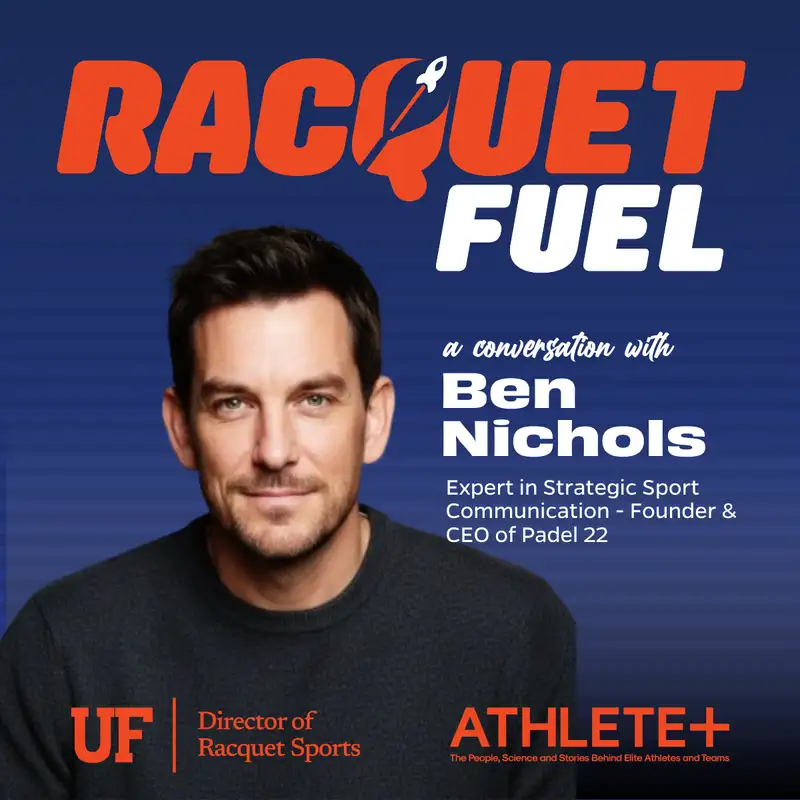
Storytelling, Strategy, and the Future of Racquet Sports - with Ben Nichols
Welcome to Racquet Fuel, where we launch into great conversations and share powerful tools to help you become a stronger Racquet's leader. Your hosts are Kim Bastable, a former All American tennis player and now the director of professional rackets management at the University of Florida. And Simon Gale, the USTA senior director of Racquet Sports Development. Today on Racquet Fuel, a discussion with Ben Nichols, a global communications expert who has made paddle his main business in the last few years. Ben explains how to develop a solid paddle business instead of just building courts and hoping that people will play.
Episode Narration:Here are Kim and Simon.
Kim Bastable:Welcome to Racquet Fuel. Excited to have Ben Nichols here today with myself, Kim Bestival, and Simon Gale. Ben is the founder of Padel twenty two, the world's first communications and storytelling consultancy dedicated entirely to Paddell. He doesn't build courts. He doesn't coach players, but he he helps the sport define who it is, how it's perceived, why it matters.
Kim Bastable:And in an era with directors directors of of Racquet Racquet Sports who are expected to lead teams, manage growth, communicate vision, future proof their programs, man, this is a confusing addition to the story. Some people are are quite unsure, and and Ben's gonna help us sort that out. So we're gonna just talk about the challenges to to leadership with the emerging, addition of Padel adding to the the pickleball and tennis and kinda what Racquet leaders are thinking about. So maybe this is what are you thinking about with this, Simon? You've got this right there on the campus.
Simon Gale:Yeah, we do, and just before we went live, I said to Ben, we're all trying to work out how to do this on the fly, and the industry's evolving from scratch, so it feels like a real start up business, but it's got a huge trajectory moving forward, and I'm excited to hear Ben's international's perspective on this, and he knows The US market well, so looking forward to the conversation. So Ben, welcome.
Ben Nichols:Thank you. Yeah. Simon Kim, absolutely delighted to be joining you and a big fan of what you what you do, and interesting time to be talking to you about paddle and the the sort of Racquet's Collective as it's coming increasingly. So, yeah, delighted to be up.
Simon Gale:So your background isn't traditional coaching or club management. And for those who don't know who Ben Nichols is, maybe you can explain what Fidel twenty two is about and maybe a a real quick summary of about how you ended up here.
Ben Nichols:Yeah. How do I end up here? Well, look. My I'm from The UK as you can hear. I'm actually speaking to you at an interesting time.
Ben Nichols:I'm shortly to move to The States this summer with my family, so big kind of my my in my professional personal life. But, look, yeah, I've had a career of about 20 in sports communications and marketing. I grew up in England as a racket sports player. I was a tennis player initially as a as a child, and then in my teens, became became a squash player. Played to quite a high level junior, and so racket sports were always in my blood.
Ben Nichols:And then career wise, I started off in the tennis industry working as press officer on the media side of things in Wimbledon. I I did some time at the Australian Open, worked at Queen's Tennis, what was then the Stella Artois Championships in London, and then worked in other sports. So I really was focused on the promotional side, the PR storytelling side on Formula one motor racing. I did for a while with one of the teams. I then spent four years in Montreal, Canada for the World Anti Doping Agency heading up media relations, which was a fascinating pivot, I suppose, and looking after the media fallout of the Russian doping crisis.
Ben Nichols:So that was an interesting time. And how do I end up in paddle while I was doing a contract for the LTA, the Tennis Federation, which unlike in The US, also governs paddle. And part of my remit was to look after publicity for the British paddle team around the world championships in 2022. And I tell you that because that's kind of the the segue into paddle or paddle. And I saw an opportunity.
Ben Nichols:There was a lot of investment, a lot of clubs and courts opening in The UK in paddle. And I I thought this is gonna be the next big sport, certainly the next big racket sport, and the obvious place I wanted to work in it, the obvious place for me to do so was on the promotional storytelling strategy side of the sport. So I set up my own agency. That's what paddle twenty two is. We're a PR, initially PR, but have morphed into a marketing social media strategy agency for the sport.
Ben Nichols:So we work with clubs. We work with the professional side of the game, Hexagon Cup and Premier Paddle, which is the global tour, and we've done work with we work Playtomic, the tech booking app, work with investors and founders and people trying to build a business profile in the sport, and, yeah, a variety of sectors. And as it happens, even though the sport is very much in its infancy in The US, most of our work has kind of become become American based along with British based, so I'm a great believer in kind of where it's heading in The States.
Simon Gale:Well, that was a jam packed minute of summer, Ben. I mean, you've had you've really had a dull and boring life by the sounds of things. I mean, it's unbelievable what you just what you just reeled off. So thank you for sharing, and I'm just gonna go in a different direction real quick here. How do you feel like the governing body being involved, like the LTA, and they've been in it for a while, and TA is now Tennis Australia is also a governing body of Padel.
Simon Gale:How do you feel like that is impacting where those nations are going versus, say, in America, the USTA has stayed in the tennis lane
Ben Nichols:Yeah.
Simon Gale:And not going down that road. So Paddell's independent here and doing it on its own. How do you feel that that's impacting things?
Ben Nichols:Yeah. Sure. It's a really interesting question, and I don't wanna be a fence sitter here, but I am gonna say it's I don't think there's a right or wrong. I think it all comes down to the intentions and the agenda of the the federation and the sort of, you know, the competency, I suppose. I'm a big fan of The US Pedal Association and what they're doing, and I think they're doing a great job and they've got, you know, bright prospects and, you know, creating an independent sport for sure.
Ben Nichols:That said, look. In the in The UK, there are a lot of operators and people who are not not particularly, you know, positive about a tennis federation governing paddle. But I think it comes down to the intentions. Like, if you can if you can build paddle and do it in a competent way and use all the infrastructure and the and the benefits that come with a massively big federation like the LTA and and the and the work it's done in tennis and use that for paddle, that's a that's a positive thing. Are there gonna be areas where there is a potentially a conflict of interest because it the growth of paddle in The UK, I'm talking, could be to the detriment of tennis in some decisions?
Ben Nichols:Yes. I think you will hit those instances, and that's where you get to a slight slight sticky situation, and that's where I think a lot of people would have have a little bit of a umbrage, I I suppose, with the tennis federation getting involved in another racket sport. However, you know, there are benefits. Right? Because, you know, if you start up your own paddle federation from ground zero, essentially, you're basically having to do it all yourself.
Ben Nichols:You're learning on the job. You don't have the, you know, the learnings from another traditional racket sport to carry with you. So, like I say, this is a slightly diplomatic answer, but there are benefits and there are downsides to being a tennis federation taking it on. I think it comes down to the competency of that federation. I see the LTA in The UK, I think, doing a steady job.
Ben Nichols:My recommendation, if if there was one would be to staff up and build more of a paddle workforce because the sports are the in the private sector, it's at a very advanced stage already. Tennis Australia have a great reputation. I don't see any issues with them taking it on. I think they've got, again, a great a great future for paddle there. There's benefits to both, but I understand why, like, a u in The US, a USPA would go down the route they have and proceed there.
Ben Nichols:You know? It comes down to what's the will from other, you know, federation, Racquet Sports Federations, you know, do they want to get involved in paddle? And, you know, it's case by case. So I think the proof will be in, you know, ten, fifteen years as we start to see the development in these countries, and then we can look at the comparisons of, you know, which is independent federations versus which is a kind of sort of Racquet Sports Federation and and how they've done as a as a an organization.
Kim Bastable:That's interesting. Yeah. That's a that's a good broad overview and very diplomatic. Well done. So let's talk a little about that US market.
Kim Bastable:I was saying before we came on, I I just don't you know, everyone talks about we have all these all these courts. I put that in quotes because compared to a few years ago, we do have a lot of courts. But it's just so we're so small in compared to the international market. Can you just give a glimpse to our listener
Ben Nichols:Yeah.
Kim Bastable:What the international market looks like and and how US compares?
Ben Nichols:Yeah. Well, it's changing by the day. It's it's rapidly growing. So, look, I I there's a couple of global reports out there on paddle. One is the Playtomic report, which is an annual snapshot of the of the growth of the sport.
Ben Nichols:You look at the last one from 2025, it's you know, there's about 30,000,000 players or 30 to 40,000,000 players depending on where you cite your statistics. There's over 50,000 courts now globally. There's, you know, I'd say about a 120 nations playing now. There's Olympic ambitions with the sport. There's a real concerted effort by the International Paddle Federation to get paddle into Brisbane if they can in 2032 as there is pickleball.
Ben Nichols:I'm very aware of pickleball's ambitions as well. But, yeah, you put that to the, you know, the the growth in The US. Let me give you an example. In in The UK, there were there's about, I wanna say, thirteen, fifteen hundred courts maybe now, and that's, you know, I would say doubled in the last year. Similarly, in The US, there's you know, the number of courts has, I believe, doubled since the beginning of 2025.
Ben Nichols:So, yes, it's super, super small in The States right now, but the the growth curve is going getting steeper. I would say in The States, I'm hearing there's kind of, you know, around 3,000, three and a half thousand new players getting on court each each month. There's probably in the hundred, hundred and fifty thousand players in this I'd say regular players in The US. It's a heat map right now in The States. You know, you've got a big paddle scene in South Florida and Miami, really playing on the Hispanic population.
Ben Nichols:You've got New York is starting the sport is starting to grow as multiple clubs now, and New New Jersey is where people are looking. Then you've got Texas is a big paddle hotspot. You've got clubs in Austin, Houston, Dallas. And now finally, you're starting to see perhaps a little bit belatedly, you're starting to see LA and and California pick up the sport. So it's happening in patches.
Ben Nichols:And I think, you know, compared to The UK where I'm from is we have strict planning planning and regulations here as you do in some states in The US. And I think it's not that there's a lack of kind of will to grow the sport quickly in The States. I think it's a lot of it comes down to the complication of building and permits and getting land. So that's gotta be a bit of a drag as well. You can't just do it overnight even if you have the investment.
Ben Nichols:So, look, it's it's on its way. It's still very early in The States, but I would say all the all the signs are positive and, you know, the credentials of the sport, how easy it is to pick up, how sort of positively addictive it is. People love coming back. It has a really high retention rate, about a 100 ninety two percent of players come back. And it's very sociable and fun, and it's a lot less technical than tennis or squash, I'll be honest.
Ben Nichols:So that has more mass appeal on paper than I think the more technical traditional sports.
Kim Bastable:Yeah. Yeah. I think that we we I mean, anybody who's played it can understand how quickly and easily it is to be picked up even at the beginner level. I mean, yes, you might not understand the walls, but you can still have a a lot of fun. But what I think we're kind of under trying to understand is the monetization of it in The US market.
Kim Bastable:And what do we see because Simon was mentioning that Orlando has added a lot of clubs, which has changed the hourly rate that's on the market. How do you see I would love to know, like, in Spain or in some of these big cities, UK. I know for my daughter in The UK, she can barely get a court even in the middle of the day. She loves to play. But here in America, it seems like clubs are standing empty in the middle of the day.
Kim Bastable:So how how, business wise, can we expect are people wanting to play this from 8AM to 10PM? I feel like in Spain, the word on the street is they do, but over here, we can't get anyone to play between, you know, nine and four.
Ben Nichols:Yeah. It's the demand and supply thing and when you meet the sort of, you know, the perfect point. You look at Spain, I think that's an interesting comparison. It started as quite elite, expensive sport, and it's now very much a sport of the masses. Like, it is super cheap to pay.
Ben Nichols:You can play for, you know, I wanna say $10.12 euros, you know, which is vastly different from some of the costs I'll mention in in The States. But there's you know, it's become the second most practiced sport in Spain. I think in Madrid alone, there was a survey about a year ago saying it's become the most popular sport with Madrid residents. I mean, that's that's that's huge, really. So very popular in Spain.
Ben Nichols:The UK is an interesting case study. Again, I would say it's probably three years ahead of The US in its paddle journey. And you've got now about 50 to 60,000 new players getting on court every month in The UK. It's growing rapidly of the number of court courts. That said, I would say somewhere like London where prices for land are really expensive, the clubs are, you know, they're charging in British pounds, $80.90 pounds, some of them per court per hour.
Ben Nichols:That seems pretty expensive and very different to other parts of The UK where you could, you know, book a court for a fraction of that price. So that definitely depends on geography and affluence and all of those obvious kind of demographics. The US is interesting. I mean, particularly in New York where it's it's well known in paddle circles, a court in Manhattan where there's a monopoly or one club in Manhattan. You know, you pay $300 an hour, which is insane to most people, but the market pays it.
Ben Nichols:Right? So right now, they can do it, and it's positioning itself as a very exclusive kind of sport. I think, you know, that will come down as with everything. As there's more competition, there'll be more competitive price price wars, I suppose. Other parts of The US, it's a lot, you know, a lot more affordable.
Ben Nichols:But it is in America right now in in by and large, I think, seen as quite an exclusive expensive sport. I think that will change because it it will have to. I just think it's market economics. And, yes, the challenge coming to your point, the challenge absolutely is always the daytime hours. So, you know, without going down too much into the weeds here, obviously, that's where kind of my work on the promotional side comes in where I'm trying to work these clubs and I'm finding the audiences who who are available during the day, whether that's retired people, whether it's school kids in the afternoons, whether it's university students who haven't got lectures, whatever it may be, who are the people that are not available in the you know, or or not just available in the on peak hours.
Ben Nichols:Yeah. It's a challenge, but like any good club, they need to be thinking about how they get people through the door, who are those audiences, what are the price points, how they get more awareness for the sport, because that's the biggest challenge right now is getting more people aware of its existence.
Simon Gale:Well, I think that segue is perfect into my question, which starts to to go down the, you know, who's leading these these sports. And a lot of them are tennis coaches who've picked up the sport and added it as a second racket sport at a facility, especially if you've got multiple racket sports, even some of the stand alone facilities, you know, we're seeing some people shift completely into into Paddell. So my question kinda centers around if a lot of our directors and leaders don't have a business background, exactly to your point a a second ago, how do I get the word out? How do I influence? How do I get people to come in?
Simon Gale:How do I build the market outside of those who walk in the door? What are the blind spots that kinda show up with a technical expert, a coach moving into a leadership role where they're trying to run a business?
Ben Nichols:Yeah. It's a really good point. And the best I'll be honest, the best, you know, coaches are yeah. They're not always gonna make them best leaders. They've gotta they've gotta they've gotta grow their grow those skills.
Ben Nichols:And, you know, you can have the best coaching program, I think. You can have the best on court experience for your players, etcetera. But, actually, you gotta think about from a business point of view, all of those other skills of managing budgets. I'm gonna think about, you know, how can you empower your workforce to be motivated, inspired. How can you be managing the overall program and facilities and and what partners are you working with?
Ben Nichols:You need to be thinking about it holistically, and I think it's gonna come down to you can't do I think about this from my perspective. I think any anyone that's trying to scale a business, you can't do it all yourself. So you've gotta have bring on the best team possible who you can trust to operate according to your systems. So, yes, it's about on court coaching, and that's all really important, and that's what players and members will remember. But, actually, you've gotta be able to gotta be able to have program I guess, processes and systems in place that are gonna allow your staff to work well, the club to tick over, you to be able to grow it.
Ben Nichols:If you're thinking about second facilities, you've gotta have things that, you know, where you you're not gonna be able to just run it yourself single handedly. I I guess what I'm saying is you gotta have as well as having a knowledge of the sport and what's gonna work on court for the consumer or player, you gotta actually have a processes that you can scale and be able to empower your team to to run for you. So I think it comes down to, yeah, you're gonna you're gonna be delegating as well along the way.
Simon Gale:Well, I think one of the things that you you're a big advocate of is is storytelling. Yep. And the minute I read that about you, it connected with me because I'm a real believer in in if we want people to connect to our sport, we've gotta tell great stories, and we've gotta tell them why it's so great. And as soon as they discover it, they'll go off and tell stories to others. I think as a leader, you have to be able to tell those stories versus be able to be a master technician or a master businessman.
Simon Gale:You have to be able to tell these stories. So why do you think being able to articulate that kind of clear narrative is a is a leadership skill that's required these days.
Ben Nichols:I think we know it's a marketing tool because, you know, it is part of many kind of marketing services you can use as telling good stories, but actually, yeah, it's a leadership tool because it comes down to rallying everyone around the cause. Right? So if you can get staff no matter how senior or junior understanding, yes, the business and all the kind of the economics and the and what's gonna make it and practical solutions, but actually, you gotta gotta be able to, know, inspire your team and get them to understand why they're doing something, get them to believe in it. That comes down to good storytelling. It comes down to people believing in something.
Ben Nichols:So in my view, it's really important to be able to, yeah, inspire and, I guess, kind of get a get a team all from the working all from the same crib sheet who understand why a business is doing something, how it's gonna lead somewhere, how that's gonna benefit them, how that's gonna make the people they're serving, the players, the customers have a smile on their face. I'm really just kind of and that could be that could be in person. Right? That that can be in person, but that can be also on your communications channels, everything from your press releases to how you speak to media, to your social media. It needs to be actually more consistent.
Ben Nichols:People need to understand why they're doing something, and then they will naturally go and do it. So they don't feel they're doing something on autopilot. They're actually believing in a cause. So what it comes down to is really having a having a purpose as a business. Yeah.
Ben Nichols:Getting the getting the getting the team you're working with to understand the why and really be be sold on that. That's the, to me, the the be all and end all if they show up at you know, if your team shows up at work and they understand ultimately why they're doing this, they'll be motivated to do it, you know, and that's what comes out to a good organization is consistency. If everyone can do that and pull in the same direction, Again, talk about it not relying on one person as a director. You've gotta have you gotta be imparting that to others.
Kim Bastable:Yeah. I mean, I think that's the I honestly see that as the need around racket Racquet Sports in general and what's been somewhat lost in the tennis world. Tennis has been coasting for a while. And although we've you know, tennis has always said it's the healthiest sport based on the data that's been out there for quite some time now, that camaraderie, that building everyone with a shared purpose probably doesn't resonate as the the loudest voice in the in the staff meeting like maybe it used to. And I think that's what we need to do around all Racquet Sports because I I guess I look at them all as being really positive ways to to live healthier lives.
Kim Bastable:They all have benefits. I'm curious about this whole conundrum. You're you're in the storytelling business. In America, we have sort of picked up this Padel pronunciation of the word, although the rest of the world calls it Paddle. But then in America, we have platform, which is also called Paddle.
Kim Bastable:So I feel like we have a problem in the storytelling. Like, how do we start the story out so everybody knows what we're talking about You know mean?
Ben Nichols:Well, for those listening, I'm gonna let
Simon Gale:Ben's coming here, Kim. He's gonna solve the problem. Do it.
Kim Bastable:Let's figure this out.
Ben Nichols:Yeah. I'm gonna be evangelizing paddle. You'll hear me saying that you'll as many listeners will know Marcus Del Pilar in the in the paddle world very well. Actually, Marcus on the call recently with a group of us, and he explained it very well. I mean, he a lot of it's down to him and starting off early with with Padel and being aware of platform tennis, and it's kind of, you know, nicknamed as paddle.
Ben Nichols:Marcus will, I'm sure, testify to this. He he said, yeah. We've we've evolved, and we now need to be moving more towards Paddle. That is the name it's used internationally. It doesn't, you know, perhaps needed any more distinction in The US now that it becomes more familiar.
Ben Nichols:So I think, you know, my my view and my hope is it defaults to paddle. I understand Padel might have been a good way of, yeah, differentiating itself from platform and other paddle sports. You know, internationally, it's it's paddle. So, look. Yeah.
Ben Nichols:Absolutely. Every call I go on in The States, you know, for those who haven't been exposed to the sport, they will be, is it paddle or paddle? So we spend the first minute or two debating that, and then we move on to the actual matter. So it's it's an interesting one.
Kim Bastable:If we're gonna be in this for an Olympic sport, we all need to be talking about the same game.
Ben Nichols:It's it's it's it seems trivial, right, and humorous, but actually, no. It's important because if we gotta be consistent in it, and if we're trying to, yeah, if we're trying to push a cause, paddle off the Olympics and things, you know, these kind of things do matter because you go you know, people need to be can't you have confusion. You gotta have you gotta have consistency and everyone rallying behind it. So I think I think we'll get there. It's definitely something that comes up, but it actually, in the last two years, I'd say if I could do a a kind of straw poll, it's coming up less and less.
Ben Nichols:So I like to think people are starting to realize the paddle rather than paddle.
Kim Bastable:Okay. Alright. That's good. So we'll we'll try to continue with the Challenge except Exactly. Alright.
Kim Bastable:So one more question here. So, you know, we're gonna be adding courts. There's going to be the decision of, you know, do we put these in? How many do we put in? Do we try to have you know, a of directors of Racquet Sports have done the addition of of stand alone pickleball.
Kim Bastable:Now will they add paddle? So, anyway, I'm just kinda curious your thoughts on The United States model of generally you know, we started as tennis. Now we added pickleball. Now we might add paddle. What what should leaders be thinking about?
Kim Bastable:What should they be willing to let go of maybe in their vision? How do we solve this conundrum of do we add? Do we bring this on? Do we not?
Ben Nichols:Conundrum or opportunity? Because I think Oh,
Kim Bastable:there we go. There we go. That's how he said it. That's the spin.
Ben Nichols:There's the spin. Look. I I think it's a fascinating time. Right? I think, you know, there's so many examples.
Ben Nichols:You look at Racquet X, you know, a b to b festival predominantly, hopefully, of its time because you come at a time when we all know about tennis and its growth and it, you know, have pretty good statistics, I'd say, off the back of the pandemic and and pickleball asserting its authority in in The States. And now paddle's starting to arrive as this third interesting addition, I suppose. And, yeah, like, I speak to operators, and it's, again, two years ago, it was we've we've got tennis and pickle, and now it's we've got tennis pickle, and we're just putting in one paddle or putting in two paddle. And that yeah. It's a perfect symbol, I suppose, of where things are moving gradually.
Ben Nichols:What's the answer to it? The interesting thing I find is, you know, I speak to a lot of paddle purists, people who are, you know, honest here. They say love paddle, don't like pickleball. But in The States right now, given the maturity or lack of maturity of paddle, I need to put in pickleball as a way of getting people through my door because they have no idea what paddle is. So they're using it as a, okay.
Ben Nichols:We'll put pickle alongside, and hopefully, they'll see paddle and be, you know, attracted to come and try this new sport they've not heard of. So they're using as a slight strategic move to get people along to their club locally. I'm seeing that happen. I'm seeing, yeah, everything you will be seeing. Tennis, which has brought in pickleball, you know, country clubs that have brought in pickleball and are now bringing bringing in pedal because they've, again, been exposed to these statistics from other countries, and they see people getting excited around the sport in The States.
Ben Nichols:What's the perfect model? I'm a big fan of, as I mentioned, growing up with tennis and squash. I love all racket sports. I'm not an either or with this, and I would my ideal club is seeing all all three alongside. I agree with this kind of Racquet's collective.
Ben Nichols:I know that might be idealistic and not what everyone sees it as, but I I'm a big believer in the more people with a tennis racket paddle, whatever it is in hand, the the more benefit to all of it. You know, it's good for society. It's good for health. It's good for social interaction, all of those positive aspects. And, actually, I think one thing you see in paddle, people talk about in paddle in in a country that's slightly further along the line like The UK is people will say the benefit to paddle will be at tennis's detriment because we'll see more tennis courts converted into paddle and and more people switching from tennis to paddle.
Ben Nichols:I think you will see that. I think you'll also see it the other way. In fact, I think you'll see people who are have never been attracted to tennis and the kind of country club environment actually play paddle because it's easier to pick up. And I think you'll get some of those people actually evolving into tennis, which is a a more complicated technical sport, if I'm honest. So I think you're gonna get people moving in both directions.
Ben Nichols:I think you'll get some pickleball players try and paddle. So I think it's I think it's a benefit to all sports to have facilities that have all courts because I think you're just gonna get interesting dynamics.
Simon Gale:Yeah. So, Ben, one of the things with being a director or leader of one of these Racquet Clubs is that you are advising or trying to influence people who maybe are not in the industry. You know, they're investors, boards, committees, city officials. What advice do you have for influencing decision makers who have to deal with that on a day to day basis and try and influence change? For example, adding paddle courts.
Ben Nichols:So if you're working within the club and as a director and you're you're influencing those who are investing or those who are not in the day to day operations?
Simon Gale:Yes.
Ben Nichols:Ultimately, they're looking at return on investment and business decisions and the the pragmatics. We know that. So you've gotta present that and all the factual information. I come back to, again, good storytelling. I think how can you bring these things to life in addition to statistics that tell a certain story?
Ben Nichols:Have a good case study of how something will impact one of your members. So it's the same as in all my work, I think. Okay. What makes a good story when I'm speaking to media? Absolutely numerical statistics because they they can't just go on speculation, but you also need a human story of how that actually moves the needle.
Ben Nichols:So if you've got some examples around how we're, you know, bringing in a paddle court based on other geographies or based on another club has increased membership or player base, that's one thing, and I think that helps influence the decision. If you can also provide a quote or a testimonial about how paddle has changed someone's life who used to play another record sport, to me, that is something that will pull on the emotional heartstrings of even the most hard nosed business leader or investor. You still gotta have something that's going to make them understand why emotionally it would be a good thing for, you know, for the clientele and the club. So, look, I think long long way of saying, it comes down to, yeah, quantitative data and things which are gonna prove a a business case, but also have some have some stories around why this would be good for your members or how it's affected a member at a similar club locally. And those two combined, I think, are gonna help you get these decisions over the line if that's what you wanna do as a director of a club.
Ben Nichols:You've gotta have, yeah, qualitative and quantitative.
Kim Bastable:Yeah. I think that's a the I I like I always say data is pretty loud and proud. It says a lot, but if you don't have some of those really kind of feel good stories, it's can be a little cold. So I think that's that's good advice. So what would you say just maybe the directors finish this sentence.
Kim Bastable:The directors who will succeed in the next decade are ones who will what?
Ben Nichols:Who will always be looking at what's next, what's coming down the track. I think you never rest on your laurels of how things are today because I think things change in every profession. Things change rapidly these days. It's a fast moving world. I think the same is in racket sports evolution.
Ben Nichols:We've seen that the last five years in The States, particularly, more than any other country, I would say, given pickleball and what that's done. So it is never yeah. Never resting on your laurels and always thinking one, two steps ahead of what's coming down, looking at global trends, looking at you know, we can see from what's happening with Paddle and and now its entry into The US, what that's done. So I think always always thinking about what's coming next because if you can be the first to do something, you know, that's credibility right there if you bring in something that's ahead of its time as well.
Simon Gale:So, Ben, we always try and wrap things up. We could keep talking for hours, but when when would you like to end the episode with you trying to maybe summarize a piece of advice or a key takeaway for those that are listening that that you would like to convey? What have you got for us, Ben? What have
Ben Nichols:I got for you? I well, it'd be no surprise to you. Invest in your story well. Come back to the the same thing. It doesn't matter in my world if I'm speaking to journalists, if I'm speaking to club owners, if I'm speaking to investors, real estate.
Ben Nichols:Invest in your story well. Coming back to what we just discussed, people will believe in the statistics and the growth and all the hard empirical data, but they will believe in how it actually affects someone's life, you know, coming back to the club. How and I've seen this a lot. People talk about how paddle has really transformed their life from being from coming out of a pandemic where we've generally been quite lonely and lacking social interaction to suddenly meeting their, you know, new best friend or romantic partner or business partner. So I would always come down to having a good story really hits home with business decisions.
Ben Nichols:With with influencing anyone is it's such an important asset, and that's you know, I think people like stories and they like hearing from people, and it goes a long way.
Kim Bastable:Yeah. I mean, I I hear you saying, you know, really loud and clear that that we really need to think about the impact this is on the players, the members, the clients, and there's just a lot of good connectivity. There's so much research around relationships and how valuable those are in our life. And, essentially, that's what our Racquet Sports are. They're relationship building tools.
Kim Bastable:And then they're healthy, and they and they move people off the couch and and into social situations. And they're such a plus. I love that you mentioned that you need to continue to grow your leadership skills. Many people do come into this business because they were great players or loved the game, and then they maybe became a coach, but that doesn't mean they understand the business side of it. Bring a team on.
Kim Bastable:Get someone else who maybe understands the business side if you're not that person. And then learn to motivate staff. That's what I I hear, Simon. It's like motivating and building that story around your staff so everybody's just fired up, come to work about the purpose they have. That's kind of what I've heard from Ben.
Kim Bastable:Do you have any takeaways in addition?
Simon Gale:Yeah. It's not having a master plan and a strategic plan that's on a piece of paper that you give to your staff and they all buy in. It's it's the leader telling us where we're headed and how we're gonna get there, and I really the storytelling really resonates because I I'm a true believer in that, and for twenty years, I've gone around clubs and managed clubs asking the question, why do you play tennis or pickleball or paddle? Why at this club? Why do you come to my club, and how has it changed your life?
Simon Gale:And they're three central questions I want someone to answer. And Yeah. The members who come back week in, week out, they have answers to those questions, and that's our job is to to inspire them to be able to answer those questions.
Ben Nichols:If I can, there's there's a there is a great thing going on in in paddle, and I'm sure this happened in pickle and and other record sports. But there's a great thing going on with, I say, people's lives getting transformed, you know, whether it's an antidote to loneliness and they find this is their new social interaction. They don't need to be in the bar or wherever it is anymore. They they're using sport. That's happening to a great extent.
Ben Nichols:You're also seeing communities form, and I a great example is there are women's paddle is becoming a big thing. In The UK, we have there's a a group called Empower Paddle. Huge numbers of women are getting together, you know, and forming kind of business relationships and close friendships through paddle. And these are people who are not necessarily considering themselves athletic or with Racquet sports people. In Miami, there's a similar thing happening.
Ben Nichols:There's Andy Newgarten, really, you know, inspirational person that herself had her life, you know, changed by paddle. She's bringing all these women's groups together in Miami, and these are, you know, business leaders. These are people kind of who've had really successful careers that have found this new lease of life through this really pretty addictive sport. And that's really I think that's really powerful when he's when he you know, in this day and age, we think we've seen everything, and we we've grown up with sports for years. But when you've essentially got a new sport that is giving people in, you know, middle age and later in life a new reason for getting together with people, I think that's really powerful.
Ben Nichols:So, absolutely, the the power the power of connection. Absolutely.
Kim Bastable:That's that's fabulous. I have to say I resonate with that, obviously. And I do think because it's new, everybody can kind of be new to it together, which is not as scary. Tennis is something that some people might be have done for thirty years, and then you're the new person. You don't fit in.
Kim Bastable:So interesting times. Really appreciate your time, Ben. You you are at the forefront. It's exciting. You're moving to The United States.
Kim Bastable:Yeah. You're working on your Anglo American Cup. You're gonna be bringing that. I know you had a successful one last year. We didn't talk about that, but that's just all the competition opportunities for everybody to, for those that wanna play at that level.
Kim Bastable:But I think the rec level just having the sociability is is a value to to many, many people. It's really exciting. We appreciate your time, and we look forward to maybe circling back on this. In another two years, we might see how many it'll be interesting to see how much of the explosion. We know it's gonna be big.
Kim Bastable:How much of the explosion will take place?
Ben Nichols:Absolutely. Yeah. No. Look. Been an absolute pleasure.
Ben Nichols:Thank you.
Simon Gale:Thanks so much, Ben. I really appreciate your time.
Kim Bastable:That's what we have for you today on Racquet Fuel. We thank Ben for his time. We look forward to speaking to you next time. Have a great day.
Episode Narration:That's all for today, but we're not
Ben Nichols:out of fuel. You can
Episode Narration:find more information and resources in our show notes and by visiting racketfuelpodcast.com. If you like what you just heard, please subscribe. And also leave a review, which helps other people join the mission to become stronger Racquet's leaders.
Conclusion:This podcast is a production of Athlete Plus, the people, stories, and science behind elite athletes and teams. Athlete Plus is the official podcast network of the Institute for Coaching Excellence, a research, education, and outreach center in the College of Health and Human Performance at the University of Florida. The Institute for Coaching Excellence offers various online certificate programs and degrees in partnership with the Department of Sport Management. Learn more today at coaching.hhp.ufl.edu.