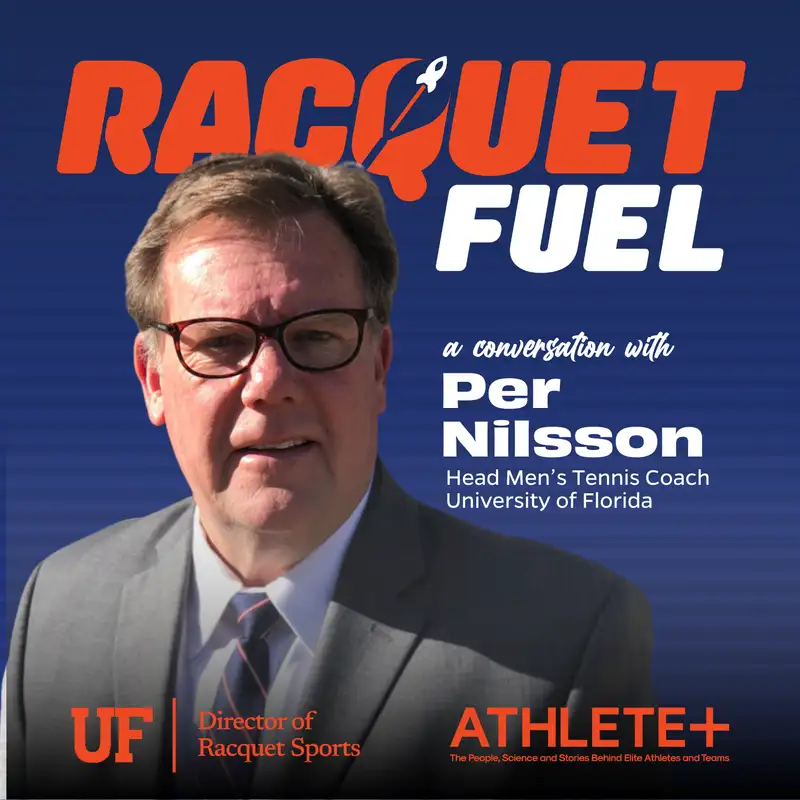
Build Better Players, Build a Stronger Culture: UF Coach Per Nilsson’s Playbook for College Tennis Leadership
Welcome to Racquet Fuel, where we launch into great conversations and share powerful tools to help you become a stronger rackets leader. Your hosts are Kim Bascome, a former All American tennis player and now the director of professional rackets management at the University of Florida, and Simon Gale, the USTA senior director of racket sports development. Today on Racquet Fuel, leadership in the college tennis space is getting tougher all the time with NIL and the transfer portal. We get a new perspective from Per Nilsson, the former coach at Pepperdine and Mississippi State, and now the University of Florida women's coach. Here are Kim and Simon.
Kim Bastable:Welcome to Racquet Fuel. I'm Kim Bastable, here with my cohost, Simon Gale. Simon, we're bringing in another Gator today. Per is gonna talk to us about college tennis, and this is not about the NIL or championships as much. We're we're going to talk leadership.
Kim Bastable:I think this is a great subject for us to have Per talk about college tennis leadership plus his director of Racquet Sports history.
Simon Gale:Kim, you are excited. I think we're in episode 60 or something like that now, and there's there's an enthusiasm in your voice today talking to another Gator, and I love it. So I am excited to hear Per talk about leadership, and and I'm always fascinated with team building standards, culture, and and parallels with with being a director of racket sports. So I'm really looking forward to this conversation. Paer, and welcome to welcome to Racquet Fuel.
Per Nilsson:Thank you so much. Happy to be here.
Kim Bastable:I am thrilled. Yes. Per reached out to me when he got the job at UF since I am a former Gator a long, long, long time ago. But I bleed orange and blue and playing for the Gators is one of my very favorite times of life. So we are we are thrilled.
Kim Bastable:And and, Per, just some research on you. I can see why the Gators hired you. Great player at Mississippi State, men's coach at Mississippi State, women's coach at Pepperdine winning almost 80% of your matches, your twenty eleven SEC men's coach of the year. So when did you notice or was it that someone noticed in you that you had leadership capability?
Per Nilsson:Yeah. I don't know if you would have asked my college coach if I was if he thought I was gonna be a college coach one day, think he would have been laughing at you. But, you know, I think it's something you try and you enjoy. And I didn't know that I was gonna be a college coach when I was younger, but once I got into tennis, I could see that being a path maybe later down the road and, you know, things things have I don't know if I'm lucky. Pick some places where you're you know, it's it's easier to be successful.
Per Nilsson:I think I've done a really good job actually picking some places where you work with good people. You know, the head coaches that I've been with and some of the ADs have really taught me a lot, and I think that helps you. And then if you enjoy that and you see that what you're trying to do with them is is working, you know, in sports, winning helps a lot. And so we've been we've been able to win a lot, and then some kinda they think that you're successful just because of that, and that's not really true, but it sure helps. And I've started enjoying it and been going ever since.
Kim Bastable:Well, I think that's the case. It's like leadership is the aspect that that helps you win. So did you have some leadership? You had some mentors. It sounds like you learned from some good people.
Kim Bastable:That might be the trick of your trade being a good learner.
Per Nilsson:Yeah. I mean, when I'm I'm doing a lot of recruiting calls right now and I not tell the recruits. I'm being very honest. I am no genius. Far from it.
Per Nilsson:But I steal from everybody. You know? When I see something that I really like or that I enjoy or I see that it's working, I'm gonna try to use it with my team and my my staff. And I see things that I don't maybe agree with from other people, and sometimes I recognize, wow. I'm doing a little bit of that as well.
Per Nilsson:I I don't like the way that looks. And so I'm a copy machine. And, obviously, sometimes you come up with your own ideas and and thoughts, but I think more than anything and and it could be in anything. It could be other sports. It could be it could be anything you see.
Per Nilsson:And if I like it, I I try it. And then if it works, I I keep going with it.
Simon Gale:Agree a 100%. We we often talk about how we steal, whether it's drills or ideas from other providers, and then how do you take it, make it your own, add it to your philosophy, and start as you get older, you start to be able to craft your own. But initially, you used to do a lot of stealing, so well said. So let's go back in time a little bit to when you were a director at a I think you had a couple of stints at country clubs and then took a director's role. But I think you went from college tennis or college coaching into those roles.
Simon Gale:So did you choose to leave college coaching and go down that country club and director's path for a little while?
Per Nilsson:Well, I played college tennis and then I had this vision, you know, maybe one day trying to be a pro, and then had a bad injury. Next thing you know, a year or two went by where it's like, hey. I I gotta figure out what to do. In the meantime, you know, I I gotta make some money. And I just happened to be in Atlanta, and a friend of mine was a director at a big club.
Per Nilsson:And he had he had a different way of of doing how he got into it. He was hired by the developer. It was a big development, and the developer hired him to set up a tennis program at that place. And as we all know, Atlanta is a hotspot for tennis. And so they hit they developer said, hey.
Per Nilsson:I'm building a new development. Do you know someone that could do what you do? And so the developer hired me. There were maybe 20 houses built, and there were gonna be about 500 homes. But the tennis courts was the first thing that they built.
Per Nilsson:So they built the courts first, and then they hired me to try to get basically, to sell, hey. This is gonna be a tennis community, and I had to start I had to start the program. So I knocked on doors. I said, hey. I'm I'm I'm starting a tennis program here.
Per Nilsson:We have a pro shop. We have everything, but there was no one there except me. And so that's how I got into, you know, the directorship, so to speak, even though I was the only person there. And then two years later, I don't know how many homes there were, and I I don't know how many players I or people I had teaching, but just about when it was time to maybe start hiring pros and, you know, a pro shop manager and all this. Then the developer was now eyeing another neighborhood, and he wanted me to now move there and do the same thing.
Per Nilsson:So that's what I did two or three times, and I never got I was on court a lot because it was getting the players and the or the not the players, the more the members of the community involved in this tennis program. And I had so much fun because it was young kids. It was the working people. It was the retired it was everyone in the neighborhood. And I tried to get them involved with the tennis program, but it was so much fun.
Per Nilsson:But it was a little bit different than just kind of going to an established place where, you know, you had a big staff and everything.
Simon Gale:So one quick follow-up on that. When you look back to those days, one of the things I pick up on there is it was only you and you wore five to 10 different hats and you were knocking on doors as well as teaching. What do you think one of your biggest takeaways or you learned about yourself or the industry in that phase?
Per Nilsson:I think I learned two things because still I was still playing pretty competitive. Atlanta, I was in Atlanta Pro League. There was a lot of pros in town, so we were still pretty competitive. And so you interacted with a lot of coaches and teaching pros, and everybody seemed to wanna be a director at a club and have pros working for them out on on the court. And I was like, that is not what I wanna do.
Per Nilsson:I enjoy being on court and interacting with the on court stuff. And so that's when I felt like I knew then that when I was gonna be older, I did not wanna be sitting inside the clubhouse dealing with members or paperwork. I I wanted to be in the action of tenants. And so that's when my mind started turning a little bit like, hey, I'm enjoying this now, but I gotta find a way somehow to make sure I don't get stuck in it.
Simon Gale:So do you think you were, well, Kim and I have interviewed a lot of people and we talk about this a lot, is that most of us are never ready for that next level job and we fake it till we make it, we learn along the way and hope that the mistakes aren't too front facing, they're more behind the scenes. Do you think you were ready? Do you subscribe to that idea that I wasn't ready and how did you kind of fast track your learning to grow into these roles?
Per Nilsson:I mean, there was for sure many things that I had no idea what I was doing and what I was supposed to do. And I remember I would go into the sales office where the real estate agents were, and I was asking them questions. I was just trying to learn as fast as I could about certain things. What was I allowed to do? What events was I allowed to run?
Per Nilsson:The thing was, I don't know if I got it from an upbringing or not, but I love talking to different people. I love interacting with people, and that helped a lot. I wasn't afraid to, like I called the developer, and I don't think he was used to that. But I I would call him and his wife and ask questions, and you just have to get in there and and try to figure it out. And I think a lot of times, we might be a little scared of reaching out when well, all they can do is say no or they'll give you the info that you really need.
Per Nilsson:So I enjoy working with people. That I think helps a lot.
Kim Bastable:I love that because we talk about this being a hospitality business all the time. And you obviously have that in you from an early stage and made a lot of connections there in Atlanta. And then you moved away from that. And so what was the choice to go back into college coaching geared upon? What why?
Per Nilsson:At the very beginning, I thought that, well, that students get the summers off, so you probably get the summers off. So then I was thinking, okay. I can go back to Sweden and visit family, you know, kinda nice. And then, you know, Christmas, you get off. And that was a complete lie, obviously, but, you know, you don't get that.
Per Nilsson:You you have to keep working year round. But that was almost the initial thought other than the fact that it seemed you know, obviously, college tennis was so much fun when I played it myself. And then my best friend from college and later had had gotten into college coaching, and he was an assistant coach. And we kinda talked, and he said, hey. When I get my first head coaching job, I'm gonna have you be my assistant.
Per Nilsson:So it became almost a waiting game for, okay. What job is he gonna get? And he got the University of Alabama. And I was in Atlanta, except they wouldn't let him hire a new assistant. The assistant had been there, had a family, and so it was the right thing to do.
Per Nilsson:So he couldn't hire me, but he said, well, the Alabama coach is going to Pepperdine, and I'm gonna recommend you to him. And I was like, I don't even know. I remember playing Pepperdine way back in the day, but I didn't really know where it was. But a couple of weeks later, I I took the job as an assistant for the men's team at Pepperdine and just dove right in.
Kim Bastable:Well, that's fascinating. Yeah. So what would you say then after you got there how leadership differed? I mean, you sounded like you had this challenge of managing the program. You may not have managed other people in Atlanta.
Kim Bastable:It didn't sound like you hired staff, but you had to manage a lot. You're doing events. You're talking to the developer. You're going out marketing. You're managing all the programs.
Kim Bastable:And now you're in the environment of a college program. So we are a leadership podcast. So can you give us a little bit of just, you know, what's the leadership aspects of how those differ?
Per Nilsson:Well, I I'm not so sure that they differ in in a in a in a broad way. There's just smaller ways that you have to now figure out. Who makes the decisions? What decisions are you allowed to make? Who do you need to go talk to?
Per Nilsson:And those are the things that I had to do when I was a director at a club anyway. And so, you know, the beginning of college, you try to figure out, you know, what's the AD's role? You know, when should I, as an assistant, be, you know, talking to them? Who am I supposed to lead right now? I was an assistant coach, and what responsibilities does the head coach have over me?
Per Nilsson:And you have to learn what's the what's the head coach comfortable with. You know, I know that as a head coach now, the last years, I lead in a different way than the head coaches that I worked with or worked with. There was one, and then my head coach that I played for. And I do it differently. So in the beginning, I had to figure out what's this what's this coach gonna be comfortable with me doing?
Per Nilsson:How do I not overstep that? And when he says, hey. I want you to be proactive and don't wait for me to do things. Okay. What does he really mean by that?
Per Nilsson:And, you know, where do I go with that? And that took a little time. And but if you if they're if you're willing to communicate with them and they're willing to communicate back, it it helps a lot. But the guessing part is the worst. When you're guessing, then then it could go bad.
Per Nilsson:You might get lucky and do the right thing, but sometimes, you you know, you're
Simon Gale:So in these leadership roles, we talk about challenges often and and it's not always smooth sailing. So what are some of the greatest challenge you've faced as a college coach? And then my follow-up to that is how do you handle those today versus how you handled them when you were young pair getting into the leadership or coaching world?
Per Nilsson:Well, I'll I'll start with the last part of that question. When I was younger, I think you get frustrated really easily, and you think that's not fair and how why is this happening? And and as you get older and you're you're in those situations, more often you realize that, hey. This is part of life, and you gotta figure it out. What do we do about it?
Per Nilsson:Is this how it's gonna be? Okay. Then how do we approach that in a different way if we have to, or is there a way to fix, you know, what we're what we're at? I don't get as frustrated anymore. I get I get more not challenged, but, you know, you're just you're just more used to it, I think.
Per Nilsson:The challenges in in in college coaching that we've been going through over the years are pretty similar. It's you know, you're dealing with young people, and you're dealing with their parents who care about their kids and want the best for them. And when when things are going well, everyone, for the most part, is happy. But, you know, you gotta keep your head on a swivel. It's like as soon as you think everything is is good, something will will show up.
Per Nilsson:And it could be anything from a death in the family to having trouble in school to boyfriend, girlfriends to loot it is there's so many things, and I deal almost more about those things than noncourt because you have a team of eight players. There's always something going on. It's a that that is a challenge, but it's a it's a part of my job that I absolutely love. Like, I love being able to try to be there for them when when they're going through this. And then you have your own challenges.
Per Nilsson:You know? You're you're not just the coach. You have a life as well. So you got family, and trying to trying to manage and deal with those things can be really tough, but really rewarding when you can when you
Simon Gale:Well, what's interesting is I didn't hear one word about tennis or forehands, backhands, serves, matches, results. They're all life skills. And I think as you get older, you realize that, like you said, you don't overreact. It's part of life and how we're gonna resolve it and move forward. And that's I think that comes with, I hate to say it, getting older and being more mature.
Simon Gale:You've just seen more of it and you deal with life better. So that's great insight and I appreciate that. One of the things that I'm interested in is culture and I'm fascinated with, in your mind, how you go about building, to use lack of a better term, the right culture. What is right in your eyes? What's important for you from a culture point of view?
Simon Gale:And I'm sure that dictates how you select players and coaches that work for you as well. So can you define or explain that a little bit?
Per Nilsson:Yeah. I think when I first became a head coach, I hired an assistant, and and we sat down that first day, we were like, okay. What are what are we gonna be about? We felt like that's something we had to figure out is what is our program gonna be about? And we had both played college tennis.
Per Nilsson:We had we had been in good programs. We'd been around good coaches. And but we felt like, well, one of the knocks on college tennis was that, you know, the the players are not always improving. That's what a lot of people were saying, and we felt like, okay. Well, that's we're we're gonna be different.
Per Nilsson:We're gonna improve our players. And then, okay. How do we do that? And we came to the conclusion that a lot of teams are really focusing a lot on the team team team and team rankings and everyone. And it was sort of like that when I played.
Per Nilsson:We every Monday was exactly the same. Every Tuesday was the same. We would all do the same drills, all all the whole team. And we felt I I didn't realize it then. I just had so much fun playing with good players, but I realized I probably wasted 50% of my time doing things that I didn't need to be working on.
Per Nilsson:I needed to be working on things that was gonna help me. And so Matt Hill and I decided, hey. We're gonna we're gonna really be working on their individual games. And if we do a good job with seven, eight players, and they get really good, we're gonna win team matches. So that was number one.
Per Nilsson:But then we also wanted to put together a culture of kid a team culture where they were actually helping each other, pushing each other. And we all know, you know, how when teams talk about that, but, man, that is really hard. You know? And and tennis players, they've been out there on their own, and some of them never even played team sports. So here we are trying to get them to push each other.
Per Nilsson:If I'm having a bad day, Simon, you gotta help me out because next week it might be the opposite. So we worked really hard on that. Those two things became the cornerstones of our program where we really focused on individual development. And then at the same time, hey. We're all on the same page.
Per Nilsson:We're gonna keep a small team because we don't want distractions of players that are like, hey. Look. I'm not gonna be playing that much, so I'm not gonna train this hard, or I'm gonna go out and do I'm gonna party a lot or whatever. No. We wanted seven, eight players on a mission to help each other out.
Per Nilsson:And it worked. You know? And I I tried to keep I kept it a secret because I didn't want anyone to know that that's what we were doing. And then I realized a couple years ago that it doesn't matter. And if other people can use it, great.
Per Nilsson:And it's so hard. It is much easier to roll out the basket and say, hey. Today, we're working on our forehands or transition. Meanwhile, Kim might need to work on our backhand volley or her serve plus one. And, Simon, you might need to work on your mental game.
Per Nilsson:And so it is incredibly difficult to, every single day, have a plan for all seven, eight players that is gonna maximize what they need to do. But I think we do a good job of it, and that's why the players are getting getting better. That's what we want.
Simon Gale:I don't know how you knew that my mental game was my Achilles heel. I just I just met you, but that was my thing. But, Kim, doesn't that sound a lot about when we talk about directive racket sports type roles, coach development, and there's your team aspect and you're building your team, and this is how our philosophy has to be delivered on court. But then one of our goals should be that we're going to customize this to the individual and how we develop them as coaches so that when they leave us, they should be better than when they started. So it sounds very similar.
Kim Bastable:Absolutely. I mean, that's how the psychological theory of mastery is right there. It's helping people to become the best versions of themselves and and very coaching every player the same differently because every player needs something different. That's that's exceptional. And I was just trying to think back to my days at UF and memory mode here and yeah.
Kim Bastable:Was that the way? No. I think we did kinda throw out the balls and all do the same things. I don't think anybody understood that like you're saying, Per. I think that's that's really good.
Kim Bastable:And just to tell a little fun story, you talked about things that get thrown in your way. Freshman year, I'm out on a training run, and I get bit by a dog. And I have to go back with the police to try to get the dog to impound the dog because it bit me and they had to check if it had rabies. Well, the guy who owned the dog took the dog away. He didn't want evaded so he'd been in trouble with the law.
Kim Bastable:So I had to go through rabies shots and those were not fun and they gave me headaches and I couldn't play on certain days and there's my freshman year story. And have you ever had someone bit by a dog pair?
Per Nilsson:I don't think I've had anyone bit by a dog. So I can't remember that. I mean, I've had a lot of things happen, but not rabies not rabies biting.
Kim Bastable:Yep. There we go. Okay. A little trivia off of my freshman year. Okay.
Kim Bastable:Let's go back to to your story at UF, and I think it's interesting that you came midyear, and you, I think, probably had some significant challenges with that. Had to I guess you landed in January. I don't know. Tell me about that transition and what was required because there are everybody who takes a job that's already existing has a transition, and it's usually somewhat challenging. But I think that's an extra challenge.
Per Nilsson:Two huge challenges. One was leaving Pepperdine in the middle of a year with a team that I built and was super excited about it. You know, that was that was not fun at all to tell them that I was leaving, both the administration and and the players. And then coming midyear, it doesn't happen very often. Coaches moves are usually in the summer.
Per Nilsson:We got some time to get used to things, and I knew there were gonna be issues here. I mean, we've all looked at Florida. We've looked up to the Florida tennis program for years. And, you know, it's one of those jobs when you're somewhere else that is like, well, that's one of those jobs that if they ever open, you know, how do you how do you not go? How do you not take that?
Per Nilsson:And so I had to take it. It was too big of a challenge for me to to not go even though it was in the middle of the year. And I knew that there were gonna be challenges here. I wasn't sure what they were gonna be, and of course, there were there were more than I thought, and that was a challenge because I didn't just step into a to a team and, like, let's go, and then I kind of do my thing. There were a lot of things that needed to be dealt with, you know, right away when I got here, during the year, and and after.
Per Nilsson:I that's a that's a part that I had never done before. But, you know, had it needed to be done. So you just have to figure it out.
Kim Bastable:Is that something you were partnering up with? You said you have an assistant coach. Like, were you making joint decisions or are you on on, you know, on your own making decisions on things through the semester?
Per Nilsson:You know, so Roland was the head coach, and and he left. But the two assistants, I decided to keep them. I didn't think it was fair to tell them, hey. You guys are out. They have families, and it was in the middle of the year.
Per Nilsson:And so I told them, I said, hey. I'd love for you guys to stay. And then at the end of the year, we'll have to see. Obviously, we we have to be it has to be a good fit. So I kept them.
Per Nilsson:And when I came in, they were they were just part of my staff. I used them as I had done my other staffs before with the difference being I didn't really know them as well. You know? And so and they had been here. They actually knew more about the team in Florida than I did, but I used them as well as I could.
Per Nilsson:And I tried to teach them everything that I see as a vision and how we're gonna do things here. And then at the end of the year, you know, we made some changes. And I think people might not see that right away that it's gonna be better for everybody in the long run, but there needed to be decisions made during the year and after the year. And those are hard decisions to make, but I I feel good about them for everyone.
Kim Bastable:Those are those are very hard, definitely.
Per Nilsson:Very hard.
Kim Bastable:So the pressure at UF is pretty real. I'm sure you realize that. There's high standards to be in Gainesville. But I also sense there's more to the UF sports culture than just winning. I've been close enough to it to know that there's a solid belief in the whole person.
Kim Bastable:Do you you know, how do you feel about that? Just, like now that you're in it, you've looked at UF from afar, and now you're kind of in it. Give us your reflection on on that. Am I right or wrong?
Per Nilsson:No. I think you're you're spot on. And I could be wrong here, but from the outside, when you're not part of Florida, you're a gator hater. Okay? And I realized you're a gator hater because you're not part of it.
Per Nilsson:You know? There there's a little bit of it's like when I was outside the SEC, I was like, oh, man. They're so cocky. You know? They're doing this and that, and you wish you were in it.
Per Nilsson:You know? You and then when you're in it, you're like, yeah. This is the best conference in in the country, of course. And it's sort it feels the same here. Like, you wish you were part of it, and then now that I am, I'm I'm a Gator baby a little bit, you know, but the feeling is unreal.
Per Nilsson:And now I also see the big picture of Florida, whereas before you noticed the sports, you noticed the tennis because you're in it. But now I've learned about because I've been wondering the last ten, fifteen years about the academics at Florida and, like, oh, they're trying to get their academic rankings up. You know? They're they were known as an athletic school, I felt like, for a while, you know, with people that were in sports. And now I got here when I got here in January and I was showing my first I was taking my first official visit around, I hadn't seen the school yet.
Per Nilsson:And I was blown away. I didn't say anything to the recruit, but I was like, no wonder I'd be losing recruits to Florida because it is a different level. It really is. And they are they are trying to be a if not the best university in the world. They're they're they're trying in all aspects, and they're not trying to cut corners.
Per Nilsson:They're trying to win in the sports. You feel that. When we're walking past the track and football and all that, you're seeing people that you see at the Olympics, and you just see it, and you feel it. And then when you go to academics and you go walk around campus, you feel the same way, and that is is really fun. It's cool to be able to tell recruits that it's like that.
Simon Gale:Perry, you've given us some really great insight into your leadership philosophy and great stories about you as a young leader and what you experience today. But if you reflect back on your career, and sometimes we don't do much of this because we're always moving forward, right? But as you tell these stories and reflect a little, how are you different as a leader today than you used to be? How have you grown through these experiences? How would you summarize that?
Per Nilsson:Well, I've noticed in my coaching that I'm using a lot of things that I did wrong when I was younger. You know? And I'm like, man, I don't want these young athletes and student athletes to make the same poor decisions that I made. I wasn't mature enough to deal with things when I was their age and certain things, and but I didn't feel like I now when I look back, I don't feel like I had someone to guide me. And so I'm I'm really trying to be there to guide me.
Per Nilsson:They're gonna make mistakes. They're they're they're they're young, you know? And so I think in the beginning when I got into this and I realized that I was leading people, I dove full in, and I was so obsessed with my job that I didn't do a good job managing myself. I wasn't taking time for family, almost like a family vacation was sort of like a recruiting trip. Yeah.
Per Nilsson:I'm going there for a tournament, but, you know, listen. And I think and it's not it's it's pretty recent that I'm like, wow. I'm a better leader if I take care of myself as well, and I'll take care of family. Because I, you know, I think I said that earlier, like, you we have issues come up too. It's not just the players.
Per Nilsson:It's the staff. It's the it's me. And you have to take care of yourself, and I'm doing a much better job of that now than the first ten, fifteen years where I'm like, okay. This my wife might not admit to it, but, you know, hey. Let's turn the phone off.
Per Nilsson:You know? Let let's take a a trip, and then when I come back, you you you can lead better. You you are a better leader instead of, like, you know, that's the only thing you do. And I did that for a year. And I think I'm still doing it, but I've gotten better at it.
Kim Bastable:That's that's good. That's good advice. I think that's something many of us who love our jobs do tend to have to do a recheck, make sure that we are taking the time to smell the roses and make sure we're living out our entire set of values. So I'm glad that you provide that. I think we also this will kind of be our last question.
Kim Bastable:We're getting long on time, but I I think I would love to just address what we all know to be true, which is the challenges with college tennis today. It's not happening in the SEC, I doubt very soon, but there's a lot of tennis teams that are being folded due to funding. So for leadership, if someone really would love the idea of being a college coach, can you provide some insights? Should they go for it? Should they hesitate?
Kim Bastable:What what do see the college tennis of the future?
Per Nilsson:It's that's a was another challenge that I was gonna bring up to Simon. I just got off track. But, no, it is that the changing landscape of college athletics for tennis has has become a big challenge. It was a big reason why I made the move that I did because I felt like Pepperdine is in the West Coast conference, small private school compared to Florida in the power four SEC big time. You know, I'm I'm trying to set up meetings here with my administrator and with Scott Strickland to try to figure out is, k.
Per Nilsson:I want tennis to be the last sport you think about if any changes need to be made. And it's you know, is it money? Would it help if I bring in you know, what if I turn the courts into a club where it's not gonna interfere with anything that we do? There's not gonna be any liability issues, but we now suddenly have the community involved. We have fans.
Per Nilsson:You know, maybe we need donors, you know, things like that. And I know they haven't done that here in the past, and that's what a lot of schools are starting to do. They're trying to make it a community hub to where, hey. You can't get rid of tennis. You know?
Per Nilsson:The community is gonna go crazy. And and and we're bringing value to not just our own individual sport, but to the program I mean, or to the athletic department and and to the university. And so it's been a lot of rebuilding this team the last couple of months. But now that I've started getting a hold of that, I think the next step for me is gonna be to try to, like, okay. We're not touching tennis.
Per Nilsson:It doesn't matter how successful they've been. You know? Maybe some of the things will be out of my hand, but I'm gonna try to do everything I can to where they go, no. No. Tennis is something we're not even thinking about, you know, making any changes to.
Per Nilsson:But it's a little scary right now for sure. And I think it's tennis in general. I mean, you look at the US Open and it's packed. But if you look at some of the smaller event, you know, I think they're they're they're all struggling with putting fans in the seat.
Kim Bastable:Yeah. So I think that's a fair reality check for college tennis and one where I think the community hub idea is being highly encouraged, and I think it'd be great to see that in Gainesville. Although I know there's a great community behind the tennis team to get people more and more on those courts would obviously, as I know, I I believe they would love it. So Simon, I'm sure you have some overall thoughts on what you've learned from Pear on leadership and maybe the Gators a bit.
Simon Gale:I am definitely more familiar with the Gators now and need to make the trip up to Gainesville from Orlando and come see you. But I have so many takeaways, but real quick. Take care of yourself first so you can be the best version of yourself for your your team. Turn the phone off. It took me a long time to work that one out too, Pear, so you're not on your own.
Simon Gale:A lot of leadership is is life skills, right? It's managing life skills in other people's lives and life is real. It's not just about the job. You're never ready for your next job but make sure you learn and ask lots of questions along the way that will help you. And I liken the changing landscape comment to what's happened in our industry from a coaching point of view.
Simon Gale:Directors of tennis five to ten years ago are now directors of Racquet Sports and the landscape has changed and clubs look different and you are now responsible for multiple Racquet Sports. And that means an evolution of you as a leader, and you have to change with it or you get left behind. So great insight, Per. I've really enjoyed listening to you and and had a lot of notes here as I went along, so thanks for sharing today.
Per Nilsson:Sounded way better when you said it. I'm I blame it on being Swedish. My English vocabulary is not big enough to make it sound like that, but you hit right you hit right on, I think.
Kim Bastable:Yes. An excellent summary of what we've learned today. And I'm really thankful to know you, thankful that you're with the Gators. I think it's an honor to be a part of the University of Florida. It was when I was an undergrad and now to be a professor as well and have this podcast.
Kim Bastable:But I think more and more, I just think it's about, as all of our jobs involve, it's about developing people. And our job is to just care for people. And I love the John Wooden quote that you need to coach them all the same differently. And and that's what I think we all need to do as leaders is be very sensitive to the people that work with us and and help them to develop the best they can in the unique ways that they're gifted. So it sounds like that's what you're doing at at UF and the team, and great luck to you this year.
Kim Bastable:Hope we have another great season. You can come up with the next version of Ben Shelton for the future future pro tour. So look forward to that. So thank you for being here, Per.
Per Nilsson:Thank you, Kim, and thank you, Simon, for letting me be on here. Really appreciate it.
Simon Gale:No. Cheers, mate. It was fun. Appreciate you.
Kim Bastable:That's what we have for you today on Racquet Fuel. We'll see you next time. Go Gator.
Episode Narration:That's all for today, but we're not out of fuel. You can find more information and resources in our show notes and by visiting racquetfuelpodcast.com. If you liked what you just heard, please subscribe. And also leave a review, which helps other people join the mission to become stronger Racquet's leaders.
Conclusion:This podcast is a production of Athlete Plus, the people, stories, science behind elite athletes and teams. Athlete Plus is the official podcast network of the Institute for Coaching Excellence, a research, education, and outreach center in the College of Health and Human Performance at the University of Florida. The Institute for Coaching Excellence offers various online certificate programs and degrees in partnership with the Department of Sport Management. Learn more today at coaching.hhp.ufl.edu.