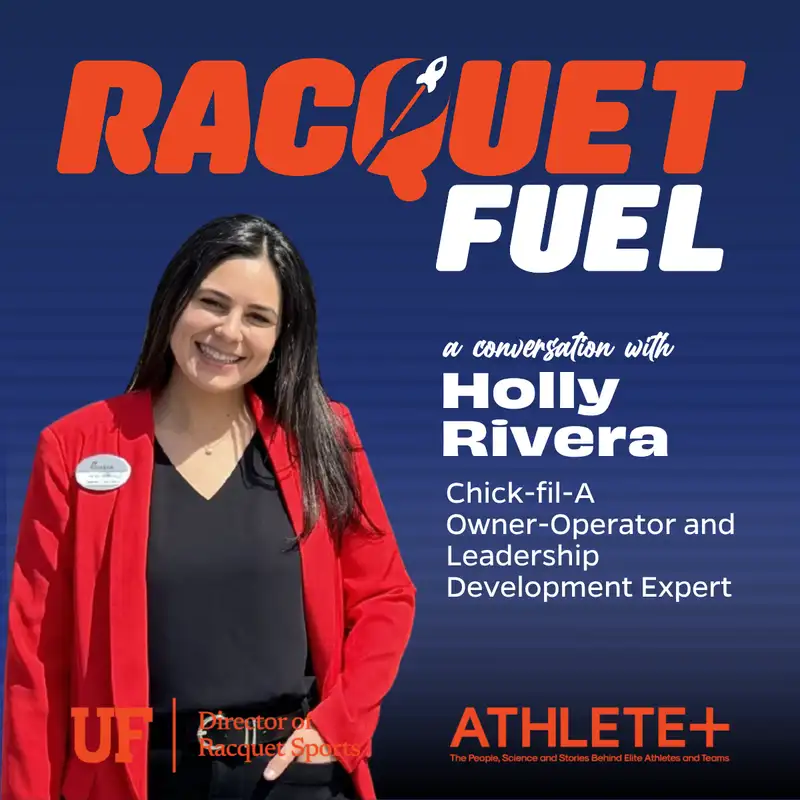
Leadership, Hospitality, and Career Pathways: What Racquet Sports Leaders Can Learn from Chick-fil-A’s People-First Success Model - with Holly Rivera
Welcome to Racquet Fuel, where we launch into great conversations and share powerful tools to help you become a stronger Racquet's leader. Your hosts are Kim Bastable, a former All American tennis player and now the director of professional rackets management at the University of Florida. And Simon Gale, the USTA senior director of Racquet Sports Development. Today on Racquet Fuel, a chat with Holly Rivera, a Chick-fil-A franchisee who helps us learn how to excel in hospitality. Here are Kim and Simon.
Kim Bastable:Welcome to Racquet Fuel. We're the show where you we serve up leadership strategies and people development methods for high performance. I'm Kim Bastable. I'm here with Simon Gale. And today, we're stepping off the court into one of the most elite leadership incubators in the world.
Kim Bastable:That is of Chick-fil-A. Our guest today is Holly Rivera. She's the owner and operator of Chick fil A restaurant in the Orlando area near Simon. It's a place we all know, famous for turning service into a competitive advantage. This is really gonna be a great episode, Simon.
Kim Bastable:I know you're excited.
Simon Gale:Yeah. I think I probably met Holly about five years ago when they first opened, and myself and our GM at the time went in and spent half a day with her, she was very gracious and clearly was just somebody that I think we're on the same way, like, with a leadership perspective and and how to operate a successful business. So she's been very interesting to watch the line out the door on the main road. That is probably why there's traffic issues on that road is because of Chick fil A. But we're really excited.
Simon Gale:So Holly, welcome welcome to Racquet Fuel.
Holly Rivera:Thank you for having me. I'm excited to be here.
Simon Gale:So I just recently read how difficult it is to become a Chick fil A operator. I read that it's statistically harder to get into than Harvard. So there's there's something there in terms of being a high achiever and a competitor to move through the ranks and end up as a Chick fil A owner. So tell us a little bit about your journey to becoming an owner and operator.
Holly Rivera:Yeah. Absolutely. So it is pretty competitive. Like you said, the statistics are challenging, but I think that is why I wanted to do it so much is because it was a challenge. And so I had started my Chick fil A journey in college just part time working just to have a part time job through school, and I had no intention of staying with the company.
Holly Rivera:That was never really the plan until my operator at the time had told me, you know, you're really good at this. Like, you should consider what Chick fil A has to offer and the opportunities you you could have with the company. And I was, like, very confused. I didn't understand the whole system. But he explained to me Chick fil A is looking for people that genuinely love serving others, people that are high character, high tenacity, go getters.
Holly Rivera:And so I felt like I fit all of the things they were looking for. So I started a journey where I ended up working for Chick fil A corporate for two years, and I ran their company owned restaurants. And during that time, it was about, I wanna say, 12 Chick-fil-A restaurants that I ran for the organization. They would say, hey. This operator is retiring.
Holly Rivera:We need you to go there. Or this operator is no longer with us. We need you to go fix what is not working. And so it was a really incredible opportunity in the leadership development program with Chick-fil-A Inc. And they gave me the opportunity to run restaurants as if I was the operator but without the risk of being the operator.
Holly Rivera:And so it was a very challenging season in my career. And so that's why it's so hard for people to get in because you either have to sacrifice on the front end and pretty much work for corporate and and do what they need you to do and serve the brand for a few years, or you have to go the external route where I'm hearing people are sitting in the pool for five to seven years before they even get an opportunity. So but they're just trying to weed out people that don't want it. And so I respect that a lot because we don't want somebody in this organization that's not willing to put the time and the effort into it.
Kim Bastable:That is impressive. The idea that you served the greater good of the business is something I think we would resonate with in our industry as we would really love people who want to serve the club very well. And then as they move up, they become the one in charge. I find your comment interesting. I was the operator without the risk.
Kim Bastable:Yeah. But, there was a lot of pressure there.
Holly Rivera:A lot of pressure. I had never experienced I mean, I was only when they gave me that that role, I was 24. And so fresh out of college, yeah, that's a lot to handle when you're only 24 years old. Like, you're running restaurants with, a 100 plus employees and millions of dollars on the line, but, that really, really pushed me to who I needed to be to have my own restaurant.
Kim Bastable:So tell us a little about the core four, which is make eye contact, smile, speak enthusiastically, stay connected. I think we all experience that when we go into a store. But how do you translate that to get a teenager or someone that's just starting with you to own those skills? I think we think those are a little little bit hard to teach.
Holly Rivera:Yeah. So I I wanna yeah. That question is very interesting. I get that one a lot. And it's I don't know if this is the the right answer, but we actually don't necessarily train for those skills.
Holly Rivera:We hire for those skills. And so if somebody does not have those four things in an interview, we will not hire them. And so in doing that, I automatically already know this person knows how to do it. And so then it's just a matter of training. When are we using these soft skills?
Holly Rivera:How are we using them? And then when they don't use it, it's a conversation of, hey, are you doing okay? What's going on? You're not smiling and you usually do. You're not really connecting with the guests and you usually do.
Holly Rivera:And that usually ends up being a conversation in my office with them crying and telling me that their car broke down and they don't know how they're gonna pay for the transmission or their dad's in the hospital. And these are things that they never would have told me unless I noticed that their smile was off, their tone was off. But, yeah, I have to have that in the beginning and then I can hold accountable because I know they know how to do it. So that's the way I do it with my 17 year olds.
Kim Bastable:I love that. So were there any red flags that you say also? Like, not having those skills as a red flag. Is there another red flag that says, yes. This isn't our candidate?
Holly Rivera:Yeah. The biggest one, and all my leaders would tell you this, and I think it's across the chain as well, but if we can sense there's, like, a lack of humility in a candidate and they're kind of like just very interested in what they can get out of something or what they have done. And I'm not hearing a lot of like, this is what I did with my team or, like, they're we're looking for team players. And when there's a lack of humility, I know that they're probably not gonna be a good teammate because those are the type of people that will blame others when something goes wrong rather than taking ownership. So that's that's probably like the number one thing.
Holly Rivera:If I can sense any type of arrogance, we just it's not a good fit for us.
Simon Gale:Well, it's interesting that when I listen to that and you talk about eye contact, smile, speak enthusiastically, stay connected, lack of humility, There's a lot of life skills in there versus experience is the number one thing we're looking for. And where have they worked prior to coming to us? They're all factors in hiring, and we hire a lot in the in the industry as well. And I think there's a lot of parallels to the tennis industry with these skills wherein, you know, we often say we're in the hospitality industry and the bracket's just the vehicle, or tennis is the vehicle. So Mhmm.
Simon Gale:Very similar. So it's interesting to hear. But once you've got them in your system
Holly Rivera:Mhmm.
Simon Gale:We've talked a lot on this podcast about how our industry doesn't do a a strong enough job of defining a career pathway. We lose a lot of really good people early
Holly Rivera:Mhmm.
Simon Gale:Who are probably potential leaders in our industry, but we lose them because they don't see a future. They don't see that they can make a living and have a lifestyle balance that works for them. So how do you go about mapping out a growth plan for your staff so they do see that trajectory?
Holly Rivera:Yeah. So it starts at orientation. My director of talent will sit down with them and we have it all laid out in our orientation pamphlet. And it shows them all the different ways they can grow in our company and then beyond, whether that is with Chick-fil-A corporate like I did or and become a franchisee or if they wanna work on staff, like say they're studying computer engineering and they end up loving Chick fil A, we wanna show them, hey, we need computer engineers on the corporate side. And from the very beginning, we're explaining to them the bigger picture of this opportunity.
Holly Rivera:And also, we'll try and figure out what is what is their dream. Like, say they wanna be a nurse. We explain to them that them even just moving up to becoming a trainer or becoming a shift leader or becoming a director in the organization, all those leadership skills will transfer and end up getting them better opportunities in their future as a teacher. Like, it doesn't matter what they're doing. And so we try and connect.
Holly Rivera:Like, the more you grow here, the the the higher you'll be up on the pole for the next opportunity for whatever career move you wanna make next. So you have Chick fil A director on your resume. People are gonna take you pretty seriously. And so that's the way we explain it to them. And they know they see all the checklist.
Holly Rivera:They see all the development, that they would have to go through. And it's all laid out and it's all in their hands. If they wanna grow, they can ask for a checklist, but it's not anything we push on anybody. They have to have the time requirements and a bunch of other like, you know, things that we require of them for each level. And if they're not ready to sacrifice something in their personal life, then they don't get to get the next opportunity.
Holly Rivera:So every we explain to them every opportunity that they can get to move up is gonna require more and more sacrifice in their life. But ultimately, it will be incremental and so they wouldn't be burnt out because they will be slowly growing those skills over time versus putting someone straight into a director role where they have no idea what they're doing and then they're burned out in three months.
Simon Gale:So as we make that transition and you kind of scaffold it and they grow incrementally and end up not being burnt out because you've gone from front desk or or front of house to managing a restaurant, you know, that's an extreme change. We see that in the tennis industry quite a bit where great coaches, so maybe it's someone who's a great, you know, front of house for you Mhmm. Gets put into a leadership role, and maybe the skills haven't been developed or they're not there at this point. And they they struggle to become great managers because they they have trouble going from doing and then becoming a leader. So have you ever had a star team member who struggled into transition to this leadership role, and how do you kinda help them shift from doing to leading?
Simon Gale:What does that look like?
Holly Rivera:Yeah. So okay. This is my vision of what I do in my organization, and so it's it might be different in different Chick fil A's. But the way that I do promotions is pretty much the team member has to already be almost doing the role before they're gonna get the promotion. So I need to see that that person knows how to do everything before I even give them that title.
Holly Rivera:Because what happens when you give somebody that title? Now all of a sudden, they're open to all this scrutiny. People have a lot of things to say about them. And so not only are they under the weight of, like, their subordinate and their superior's opinions, but they don't know how to do the job yet. And so it's like a whirlwind of chaos.
Holly Rivera:And so I explained to them like, hey. You're gonna be doing things in the next couple months that you are not gonna get paid extra for in the next couple months. But if you do not show that you are able to handle these things, you will not be able to get that next pay raise. And I'm not gonna put you in a position where you're gonna fail. And so this is just the way that I do it.
Holly Rivera:And honestly, it's been working extremely well. People are willing to put in a couple months of, you know, maybe they're getting the same wage as they were as a shift leader or a people leader, but they know that the reason I'm doing that is to protect them in the long run and they can kinda resonate with that. And and they know, okay. My time will come when I get that promotion and the money will be there and I'll be way prepared for it. I want them to feel like, oh, I've already been doing this for months.
Holly Rivera:This is nothing versus like, oh my gosh. Like, I feel so overwhelmed.
Simon Gale:And do you find that there's people who aren't receptive to that or open to it? They're okay to stay where they are and just kinda move laterally within their job versus and so do you you go through a process of recognizing that, having these conversations? Conversations?
Holly Rivera:Absolutely. And we'll tell them, like, we we just don't think you're ready. You don't understand. You don't know how to do these things yet. But that's why we have also created, like, lateral paths where they can maybe maybe they're really, like, detail oriented and they wanna become part of the catering team.
Holly Rivera:So catering is like all logistics, timing, ordering, all of that. And so they get to they can then do like a a lateral move and become a specialist. We have like training specialists. So like people who are really outgoing and they really love to do things the correct way, but maybe they don't know how to influence like an entire shift. We can give them the opportunity to grow into a training specialist.
Holly Rivera:And there is incremental increase in pay. It's just not the same amount as you would as if if you move into the higher position. But they're still growing, adding value. And we found that even if they just stay in that suite, that little spot as a specialist for six months, they feel it kind of, like, bridges a gap where they don't lose interest in the organization, but it gives that little room for those soft skills of leadership to keep growing. And then they usually become shift leaders in their in their time.
Holly Rivera:I've noticed college kids, they are stressed out during certain semesters, and it's just not the time for them to be pouring into their work. But then when that semester ends and they've done the the character development, then they are ready when their schedule is not as stressful.
Kim Bastable:I love that. I'm a little bit curious. Can you give us some context for the number of staff that you have at at at Chick-fil-A and and what like, within a store, I understand there's corporate beyond, but within a store, how many staff are you working with and how many different role titles are there within just your store?
Holly Rivera:Yeah. So each so that's a neat thing about my role as the operator, the the owner operator. It's like I get to decide what those roles are, how many people I want. Like, that really is all in my control. Corporate doesn't tell me what I have to do in that regard.
Holly Rivera:So every Chick-fil-A is a little bit different. But I would say if you're looking at like the average Chick-fil-A restaurant is probably having around a 100 plus employees. Around a 100 would be average. And then the amount of roles, I would say maybe like we have like a red shirt and then usually we have like a a senior red shirt. So we call them like a blue shirt and then a shift leader, area leader, and director.
Holly Rivera:And so that's kind of like the pipeline in my organization. And then once you wanna be with me for you have to commit three to five years if you really wanna like put roots down in Lake Nona and and be in my organization, then I have a executive director role, which is a genuine, like, career path role where they're making good money and, you know, it's not like a a pass through job. Whereas most of my other levels, it's like, I might just have you for a couple years before you move on to the next thing. And then specialists, we we have specialists for every area because we want as many people to know how the business works. So we have an inventory specialist who knows how to order the truck and and organize the inventory.
Holly Rivera:We have a maintenance specialist that knows how to change it out a part on a Henny machine or unclog a toilet. Like so they all have, like, little roles that they can play in the restaurant, and it helps when you, like, lower the amount of responsibility but increase their value. So that's why we have those roles.
Kim Bastable:This is fascinating. I think we've all been there and watched this machine happen. So it's just and it's there's just so much going on behind the scenes that we're not we're not seeing. But so the the consistency of this friendly smile is happening from the beginning, and I'm just curious. What does training look like?
Kim Bastable:Somebody is hired. They are going to start on Thursday. How long is it before they get into the formal role? How do you train that person? You've you've said that they come with those core four, but what does training look like?
Kim Bastable:And then do you repeat training? Do they do something before they do day one at at their job, and then every two weeks, every month, you do further trainings. What does what does the training schedule look like? And is it specialized per person, or do you have group store training?
Holly Rivera:Okay. So it is specialized per person based off of what they sometimes people have just different strengths. So certain positions, maybe they might be really, really good at figuring out how to do the iPad and take orders, but maybe they struggle with, like, hand eye coordination and and accuracy when bagging the orders. And so we will tweak some of the training depending on strengths. But overall, my training process is broken down by shifts.
Holly Rivera:And so I have all of the positions in the restaurant. So usually, you're hired either for hospitality, which is like a front of house employee or kitchen. And so I have, I wanna say, eight or nine positions in the front of house. And so they will have eight or nine shifts for each. So they'll have a shift for each one of those, a good four to eight hours where they're with a trainer practicing it.
Holly Rivera:They're getting all the coaching. And then halfway through the shift, they sit down and they actually go through all of our corporate pathway, which tells us the exact requirements for that position. So that way they're hearing it from my trainer. They're hands on. They're seeing it and reading it in a corporate layout.
Holly Rivera:And then usually within two to three weeks, they're ready to go on their own. It's not a long process. And then there's just continual coaching and feedback from their trainers and their leaders. But usually if I'm seeing that someone is not picking up their their role by three weeks, then we're having a a training PIP, which would be a performance improvement plan of like, hey. These are the things that if you do not improve on within thirty days, you will not graduate training and you will not be able to work here.
Holly Rivera:And that's just how it is. And I and I can tell the the sharp ones that I know who are gonna become leaders for me in the future, they just pick it up within two to three weeks.
Kim Bastable:And then after that, is there further like, do you do team trainings, like all 100 at all?
Holly Rivera:No. Not trainings. We would do we do recurrent. We do, like we call them retrains. So my training director, like, say she's seeing from customers that our fries are not meeting their expectations, our waffle fries.
Holly Rivera:And so she will take her admin time for that week, and she'll go through and retrain every single kitchen team member the proper procedure, every single step for making the perfect waffle fries. And then she'll mark that off and turn that into me and show me, you know, this is what we retrained on. Let's see if the scores improve on this. And then we can do the same thing with breading chicken, with making salads, with taking orders, with bagging if accuracy is the issue. And so she's really responsible for any retraining, and it's only usually based when we're getting things marked off on assessments, customer feedback, or corporate inspections.
Kim Bastable:Wow. There's a lot of detail there, which just shows, and we all feel it when when we're shopping, buying it at a Chick fil A. You were noted you mentioned early on that your someone in the pipeline early on identified you
Simon Gale:Mhmm.
Kim Bastable:And said, you should look to the next level. You should consider this as a career. We say that repeatedly that we think that's how tennis professionals, they need to keep an eye out for those really great diamonds in the rough and encourage them and help them find a pathway. So what do you have you been doing that? And how do you find those?
Kim Bastable:What do they look like?
Holly Rivera:Well, they all look different. And I think that's why I love my job because it's like a scavenger hunt every time. But I think the thing that I've noticed the most is there is it's hard to explain it, but there is a level of influence that a person can have in an organization even without a title. And it looks like people go to them when they have a problem. People gravitate towards them because they're just so fun to be around.
Holly Rivera:People trust them and people just genuine like, you can just tell. And I can start to see even when they're just brand new hire, I can tell within a month or two who is able to naturally gain influence with others. And then I just start speaking that into them. I'll say, hey. Do you notice?
Holly Rivera:Did you notice how Gerardo just came to you and asked you that? You're a red shirt. You're not even a shift leader. That's crazy. Right?
Holly Rivera:And I'll just, like, help them start to see and be aware of the way that people are interacting with them so that they can start seeing it in themselves. And then I work with them through a whole model of it's a system I created of character competencies of how they can use their influence once I've convinced them that they actually do have it because some of them really don't believe they do. And I'm like, no. You really do. And I explained to them how being, like, a really good leader and being one of character is how you really make impact in the world.
Holly Rivera:And so we go through that leadership development once they believe that they can be a shift leader in the organization.
Simon Gale:But I keep hearing it sounds like you're very invested in this. I don't question that, but I I'm surprised a little to hear how much you're talking about having these conversations
Holly Rivera:Mhmm.
Simon Gale:With these people, and it's not your manager. And I'm sure I saw those others doing it as well.
Holly Rivera:They do.
Simon Gale:But it's refreshing to hear how much you're invested in it versus I'm owner and operator and everybody else does the work. Yeah. Like, you're having these conversations. So that's very refreshing to hear, but also just interesting as I think of the size of your operation. We talk about a 100 people Mhmm.
Simon Gale:That you're you're in the weeds having these high level conversations investing in people.
Holly Rivera:But those those the thing that I think a lot of leaders don't they think, oh, that's gonna take so much time. And that conversation I just had with you could change like, literally could have changed that team member's life, and it took two minutes. And then what I do is I help them get on a path. And so when I say character competency model, I do create that, and I do go over it with them at a high level. But when it goes down to, like, the nitty gritty meetings and the details and applying it to their their strengths and weaknesses in the business.
Holly Rivera:All my directors do that in the business. I'm not sitting down for an hour at a time with a brand new team member talking about that. That's what my directors do. They do a lot of that development, but I do a lot of the initial like, hey, I see this. So that way they can see it, hear it from me.
Holly Rivera:And then when my directors are trying to help coach them, they have my voice of like, no. Miss Holly believes in me that I can do this. But no. I'm not have like, these is not like a ton of time invested in this. I don't want you to think that I'm spending all my time doing that, but the little bit
Simon Gale:of time appreciate that, but I I I love hearing I've had these conversations. I love that you're connected to that. Absolutely. We've talked about developing people on the way up. What happens when you lose somebody?
Simon Gale:Maybe they move on onto their own opportunity to become an owner operator, and you lose one of those key people. When you lose that institutional knowledge, how do you keep that pipeline full?
Holly Rivera:Yeah. So I actually have had one of my leaders go through my organization, went through the whole pipeline, and ended up getting the same job at corporate that I did, the leadership program. And she actually is opening her first Chick fil A in May. So that is like one of the highlights of my career that I was able to help somebody get through one of the hardest things to get through and from the from the bottom. And so I was really proud of her for that.
Holly Rivera:But, yeah, when we lose people, it can be extremely stressful. I hadn't have noticed. And so just have been doing this now for fifteen years. Five of Chick- A 10 as an operator and decided that nobody gets to know anything in the business that at least two or three other people don't also know. And so at any point, say my executive director decides he needs to retire or he's gonna move or whatever.
Holly Rivera:I have two other executive directors that know how to do everything he knows how to do. And he also has a whole inventory team and maintenance team that there are, like, five on each of those teams that know how to do the tasks. And so even if he were to step away, like, he went on vacation. We think he was gone, like, almost two weeks last month because he had a work trip and then he took a vacation. And the business was completely fine.
Holly Rivera:Right? It didn't even feel like he wasn't there. Not because he doesn't add value when he is there, but because he has developed and taught everybody everything he knows how to do. And so ultimately, he's the most responsible one for those things. But if for any reason he wasn't there, every task is known by multiple people.
Holly Rivera:So until I'm ready to promote somebody into that role, I don't really have to rush to do that. I just divvy up his responsibilities evenly amongst 20 people, and then nobody really feels that weight at once.
Kim Bastable:You know, as I hear you talk, I have a feeling there are some people in the organization that are older than you that you are leading and managing. And that is a challenge I think a lot of new directors of Racquet Sports, they might find there's a seasoned pros ten, fifteen years older than them that that that they are now in charge of. How have you overcome any challenge there or or is that always continue to be a struggle maybe? I I don't know.
Holly Rivera:No. That actually has not been a struggle for me. And I think the reason why and it's just from what they've told me is they they believe in my vision. They believe in me and they know that I believe in them. And I give them a lot of autonomy.
Holly Rivera:And I create roles for them that are very handpicked and customized to their strengths. And so they really love their job. And so it's never been about, I'm over you. I'm your boss. I've never had that.
Holly Rivera:I'm like, hey, I need you because you have so much expertise. Like, do you wanna be a part of this with me? And, it's really worked out when you have that kind of heart behind it of like seeing the value in in in everything that they bring to the table. And they have never overstepped my authority, but they do challenge me, which I want.
Kim Bastable:So Yeah. Which is good. Yep. Yeah.
Simon Gale:So, Holly, I wanna ask you about second mile service
Holly Rivera:Okay.
Simon Gale:Which is a Chick fil A philosophy, I guess, where you go beyond expectations. Might be walking an umbrella out to a guest car or in our industry, a teaching pro staying five five minutes unpaid, so to speak, to help somebody master a grip or change their their their racket grip or something like that. So how do you hold a team accountable to those types of standards when it's like lunch rush and the situation's a bit chaotic and the pressure is on, which is a situation we deal with a lot as well. So I think there's some real parallels there.
Holly Rivera:Yeah. I think I we we teach them, one, you don't have to do it for every single person. And I think when there's this pressure of, like, I have to perform for every single person and make all these moments and do all these things, it can feel like very stressful. But what we encourage them is like, hey, how about twice during your shift? Because then we have like 35 people on shift.
Holly Rivera:That would be 60 big moments that could happen. You find a guest that you could really go above and beyond. And then we realize that a domino effect starts happening and they see how that impacted the guest and then they just wanna do it more and more. And so rather than like requiring them, hey, it's busy. You also have to go and do this.
Holly Rivera:Like, we're just encouraging them to find moments and to see people. And sometimes that doesn't take more than one extra question or looking in their eyes just a little bit longer to create a moment that really can impact a guest's day. And so, yeah, I wouldn't say a lot of, like, big moments are happening at the 12:00 hour because our big moment is that you got back to work on time with the right food and it was hot and yummy. Like, that's important. And so as long as that's happening, then we can build on top of that for second mile.
Holly Rivera:But they they just have to know how to read it. There are definitely times in the business where you can go above and beyond and take more time, but probably not 12:00.
Kim Bastable:This has been fascinating, and I I think that there are many parallels. And I I think that we need to learn this service element that you have, and I think it's a a highlight of the experience of walking in or driving through a Chick fil A, this feeling of hospitality, it's it's very it's surprising in a good way, which it seems so simple to have someone respond to you in such a positive way. But what are some things that, you know, you may just think that we we haven't covered that are the secrets of Chick fil A? What what makes it special? What what what can we in the Racquet's industry learn?
Kim Bastable:What would be your wrap up your lesson for us?
Holly Rivera:I mean, I think the biggest thing and why I'm why I'm with Chick fil A is because we we wanna be a part of something bigger than ourselves. And we believe, like, Chick fil A as a brand has the power to, like, genuinely change the world. And I believe it has over the last, you know, 50. I would just find that, like, what is that in your industry? Continue to always go back to like your purpose and why are you in the Racquet industry and making sure decisions are like coming out of that and not out of fear.
Holly Rivera:Because I think a lot of times as leaders, we can make decisions out of fear rather than out of, like, and vision. And that's usually when we can lose our engagement in our excitement for our our job. And we wanna make sure we're infusing joy back into our job. And how do you do that? It's through your why, changing the b to the y.
Holly Rivera:So that's how I explain it to my team. When when the job is feeling like a job, take away the b at a y and remember why you're here, and then you will find joy. So that's a little way I help my team remember that.
Kim Bastable:Lot there, Simon. What are your takeaways?
Simon Gale:I didn't even know where to start. There's so many good ones. This is why I like talking to Holly. I think there's so many parallels with our industry and and leadership. And from the first time I met her and we talked about Pathways and so on, I've been intrigued.
Simon Gale:And I learned a lot today around just the intricacies of Pathway and even the the lateral moves for people and finding ways for them to feel like they're growing. So it's almost like a little plus within their their role versus a new job title. Just the constant message around understanding your people and investing in them. My favorite takeaway was just clearly how much you care about your employees and the story about the the leader who is going on to be an owner and operator, and that's one of highlights of your career. I think that just shows the level of care you have for your people.
Simon Gale:And I love how you finish with make decisions out of purpose and not fear. I really like that. So, Holly, you've been amazing. We've really appreciated this time. We could fill half a day on this, but we've only got thirty minutes or so.
Simon Gale:So thank you so much.
Holly Rivera:My pleasure.
Simon Gale:There'll be lots of little nuggets that people take away from this.
Holly Rivera:Totally.
Kim Bastable:Absolutely. For sure. I mean, I feel like we've we've had a lesson in in the reality of this business that we experience every time and and a little behind the scenes. I do like that you consider something special as a way to maybe move within internally in the short time. You mentioned six months in a position and then move.
Kim Bastable:Mhmm. And I think that's interesting is what we've learned at Gen Z in this in Racquet Fuel is that there is some level of desire to move up quickly and and and to just move to feel like they're growing. And and so to think about maybe making those changes, and you don't have to wait a year, you don't have to wait two years, that could be a secret sauce that that we take away. And it could be a lateral move, but you're learning something new, which is going to make everyone feel better and feel they're growing. So Absolutely.
Kim Bastable:Yes. Thank you very much. We really appreciate anybody who goes to USDA campus needs to visit the Lake Nona on what's the road that it's on?
Holly Rivera:It's on Narcoossee.
Kim Bastable:Narcoossee Road, Chick Fil A in Lake Nona. So might might run into Holly. We really appreciate your time. We may very well have you back to discuss a little bit more of the detail because it's a a great business, and you are clearly a a good leader. So thank you very much.
Holly Rivera:Thank you. It's my pleasure. Thanks for having me.
Kim Bastable:That's what we have for you today on Racquet Fuel. We look forward to hearing your comments on this, and we'll speak to you next time. Have a great day.
Episode Narration:That's all for today, but we're not out of fuel. You can find more information and resources in our show notes and by visiting racketfuelpodcast.com. If you liked what you just heard, please subscribe. And also, leave a review, which helps other people join the mission to become stronger Racquet Leaders.
Conclusion:This podcast is a production of Athlete Plus, the people, stories, science behind elite athletes and teams. Athlete Plus is the official podcast network of the Institute for Coaching Excellence, a research, education, and outreach center in the College of Health and Human Performance at the University of Florida. The Institute for Coaching Excellence offers various online certificate programs and degrees in partnership with the Department of Sport Management. Learn more today at coaching.hhp.ufl.edu.