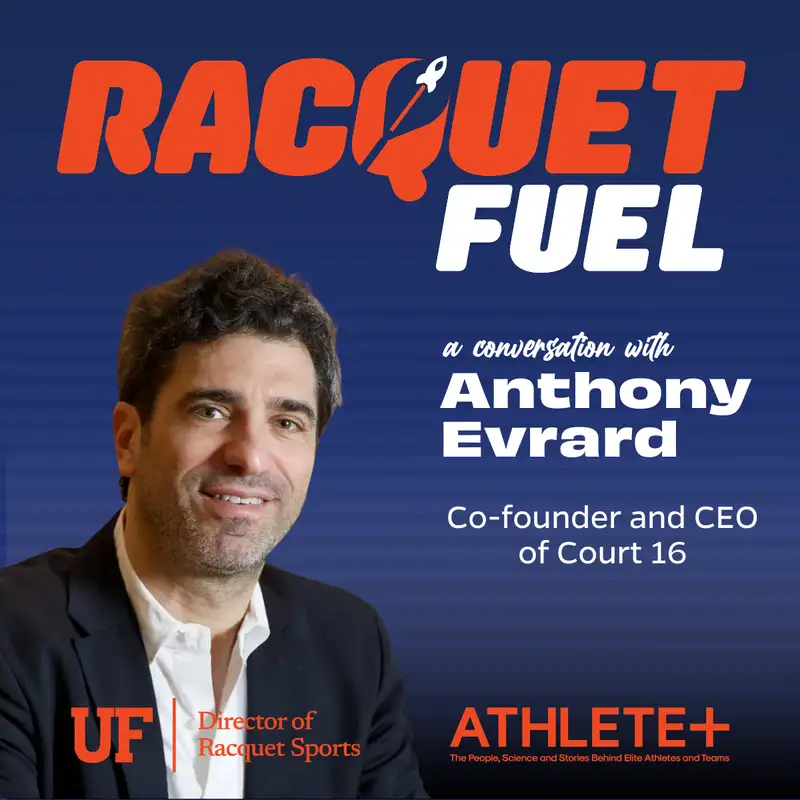
Designing Tennis for the Modern Family: Innovation, Adaptation & Urban Growth — with Anthony Evrard
Welcome to Racquet Fuel, where we launch into great conversations and share powerful tools to help you become a stronger Racquet's leader. Your hosts are Kim Bastable, a former All American Tennis player and now the director of professional rackets management at the University of Florida. And Simon Gale, the USTA senior director of racket sports development. Today on Racquet Fuel, Anthony Evrard is an entrepreneur who's created a unique offering in the rackets industry, and it's working as he's quickly opening new locations. What is his secret product, and what can we learn from his leadership expertise?
Episode Narration:Here are Kim and Simon. Welcome
Kim Bastable:to Racquet Fuel. I'm Kim here with Simon Gale. And, Simon, today, we're joined by Anthony Evrard, founder and CEO of Court sixteen. This is an intriguing business. I I love it.
Kim Bastable:It started as a progressive approach to youth tennis, combining the fundamentals with a thoughtful experience in order to connect kids to the sport. We've learned from Anthony. It's evolved a bit from there. You know, these are new ideas and new ways to teach them. I love the innovation here.
Kim Bastable:What do you think?
Simon Gale:Look, I used to work in in Westchester County, New York, so I was aware of Court sixteen starting up in Brooklyn, I believe it was, Anthony, or New York City. I I don't remember which one it was, but I followed closely, and it was it was curious to me, and it was very unique and kind of a niche approach. But he's growing and expanding, and I've and I've I've kept in touch and and and crossed paths a few times. It just sounds like things are going great. So, Anthony, welcome to Racquet Fuel.
Anthony Evrard:Kim and Simon, thank you so much for having me, and thanks for your contribution to the sport and creating those conversation that really take Racquet Sports in general to the next level. So thank you.
Simon Gale:So tell us a bit about the the business of Court sixteen and and what inspired you to get it started. Where did this come from?
Anthony Evrard:Court sixteen started in 2014 in Brooklyn, very close to the Barclays Center. As you guys may recall, at that time, there was a lot of energy in Brooklyn with the the Barclays Center being born and the the Brooklyn Nets, the basketball team moving from Jersey to Brooklyn. A lot of entertainment happening in Brooklyn, and we wanted to create a club that's really designed to get new players into tennis, people who don't have the the the time or the the the bandwidth to wait at the parks, the indoor tennis club, sort of the legacy club does doesn't necessarily talk to them as much, and they don't necessarily wanna belong to a country club. So we saw an opportunity to get new people into tennis. As I've learned over the years, and tennis is one of the most difficult sports.
Anthony Evrard:I'm always following that ESPN ranking of the most difficult sport that they publish every year, and tennis is always one of the top five most difficult sports, and they rank that on seven different dimensions. So I think for us, we'll grow up playing tennis. It's also important to always try to remember to think like a beginner, and that was the insight of the early days of, like, how can we do something that's that's that's welcoming, you know, for new players? How do we get families with young kids excited about playing tennis Because we're competing against a lot of other activities, right, not necessarily against other clubs, but we're competing for time. So the idea was how do we create an open space where parents can follow the classes?
Anthony Evrard:How do we educate our team so that anyone that works at Court 16 can talk tennis, can educate the parents on what they learn, how can we have a thoughtful lesson plan every week that all our coaches are delivering, and how do you get parents to go home and talk about what the kids have done on the court? How how do we join the the conversation at the dining table? What can we do to be a part of that?
Kim Bastable:No. I love that story. So as I understand it, these are courts inside buildings that do not have 35, 40 foot ceilings. So that's why you've catered to this younger set and more beginner set. Is that that right?
Kim Bastable:Can you fill in those blanks?
Anthony Evrard:Yeah. So we we we did without being too sophisticated, we did some pretty simple simulations of, like, what ceiling height do you need to play with Red Bull on 36 foot court and then 44 foot court. And we realized that if the ball goes too high, you know, the you don't really necessarily need those kind of ceiling height to introduce the sports, you know, to young players. And that morphed into more of an adult base just listening to parents. Because what we realized, we started the program with Red Bull with always a focus on really high quality instruction in a welcoming environment.
Anthony Evrard:We we never will deviate from that. That's always gonna be the sort of the fundamental of how we want people to feel. We want them to feel really welcomed. We want them to see the quality that's uncoated. We want them to understand what skills are they acquiring on a on a weekly basis and and seasonal basis.
Anthony Evrard:What are they working towards? And, yeah, we we wanted to be in the heart of the action in Brooklyn close to the the Barclays Center, and we found a really cool industrial building for First Club in 2014 that was sort of like the the foundation for where we are today.
Kim Bastable:That's great. So how are you looking at success? What's the definition for you? Is this all money based, or how do we how are your other metrics maybe? Hopefully, there's some other ones.
Anthony Evrard:Yeah. I mean, success is really, you know, making an impact in the community, seeing clubs that are alive and building a programming that that makes something happening in the community. Really, financial success is always gonna be something that follows. Success early on is really, you know, getting people to the club, getting to understand what they want, and each community is gonna respond very differently. So we just opened, for example, seven months ago in Philadelphia, and we never expected that that location in the neighborhood of Fishtown would be predominantly adults, adults who want with more or less flexible schedule with a good amount of players who want private lessons in the morning, who want instruction at night.
Anthony Evrard:And then you have neighborhoods like Brooklyn where we open where, you know, 90% of everything we did was all kids. If not, 95% was all kid centric. Right? So it's it's really about having a a good portfolio of services, having the team really that delivers those services with the consistent energy that we have at Court 16, and and then listen to the market and list listen really closely and respond very fast. And when I say respond really fast because, you know, operating a business in New York City requires be because of the the operating constraint that you have, everything is very pricey.
Anthony Evrard:Everything is expensive. Right? You don't have you don't have much room to listen to people for six months. Have to respond very quickly and close because people want they want they wanna be heard, and they want results right now. You know?
Anthony Evrard:If they want certain services, it's it's really key to to listen, to be collaborative, and to react quickly.
Kim Bastable:Okay. So that that requires a good team on your part. I imagine, you know, there's multiple locations, so there must be multiple Anthonys in this deal. How are you getting your staff? Who's your ownership group?
Kim Bastable:How have you built your team? And and maybe the people that are actually delivering on the courts, you know, are those just former college tennis players that are coming into the coaching world, or or who how are you developing?
Anthony Evrard:So we had to be clubs in New York City until a few months ago. So everything has been intentionally, we really try to build a team where we we've we've been very fortunate, very grateful. The seven of the the first 10 people who started at Core sixteen are still with us today. And number eight is actually just came back yesterday. He's going to be leading a club in Boston that we're opening in a few weeks.
Anthony Evrard:So we've been, you know, building great relationship, but take take a lot of pride together with my partner, Roma, who's based in Boston and was the cofounder of Court sixteen. We have another cofounder named Matthias, who's the head of design, who's a world renowned architect, who's really looking at the design of our clubs and how we kind of set the right stage in every building that we operate. So that's the question in terms of, like, who's involved at the sort of foundation level. It's it's essentially, Racquet Designing and myself who really lead. What neighborhood do we go into?
Anthony Evrard:What typology of building? What type of programming are we looking at in in this neighborhood? And then in terms of operating as I said, we have been able to develop a lot of careers within Port 16. So the the group of of team members that's really working at the central level to deploy, you know, how do we think about pricing, how do we think about marketing in this community. Most of those folks have been with us for many, many years.
Anthony Evrard:So we we don't need many Antennis. We need one Anthony, and we need many other people who all bring their own expertise, functional expertise, and and do their thing. So my my my role together with Racquet is, you know, identifying the best talent we can find, bringing a sense of of structure, flexible structure because the market is changing all the time. And now as we grow outside of New York City, we need different types of expertise, different expertise to to be successful in each market. So we have an operating structure at each location.
Anthony Evrard:We have the on court and the off court team that runs our club. We have a central team that's really providing the tools for them to be successful. And at the club level, of course, our coaches, we have a a variety of coaches. Right? We have any anyone from, you know, people who've been with us for many years who are building a career in sports, a career in tennis, and those more senior team members.
Anthony Evrard:What we try to do is to provide a platform where they're also product managers with the managers of of a vertical. It could be the Red Bull program. It could be tournament series. It could be the content for camp. It could be Pickleball leagues.
Anthony Evrard:Right? So we like to have ownership in each one of those vertical and provide a good toolbox for each one of the those team members and and let them do their thing. Of course, we try to have good consistency between each one of those programs across locations, but you're always gonna have local nuances. And then to answer your question about the the ownership structure, we are privately held. So we have about 15 individual investors who invested, believed in the company some twelve years ago, and most of them are still with us today outside of a couple of people.
Anthony Evrard:Everyone is still with us today. And then we've benefited from a couple of strategic investments over the last few years. We have we're very, very proud to have received an investment from Babelat, the Racquet company. We are today the only club in the world that has an investment from Babelat. Right?
Anthony Evrard:So they they're part of the ownership structure, and they're they're on a board, and we do a lot of really interesting stuff together with them. And last year, we had the USTA through USTA Venture joining the company as well and joining a board. So it's been it's been really wonderful to collaborate with with everyone.
Simon Gale:It's a great story, Anthony. I mean, there's there's a lot to unpack there, isn't there, Kim? But I think one of the things that I think is unique about what you've done and you've explained this already is that you didn't go for a traditional tennis club setup. You don't have 78 foot courts and and high ceilings. You've used unique spaces.
Simon Gale:What what would you say that you do well that a traditional club could maybe pick up on, especially when I look at things like when Red Bull Tennis came in and court started to get utilized differently and we would have six mini courts on a full size court, and it was a way to generate revenue. That that was a real win for for tennis clubs. Any thoughts on that?
Anthony Evrard:Yeah. I think one of the things we've done well is engaging the whole family. Right? So when when we see a family that comes with a five year old, we always say internally, hey. We have two people that need to be happy when they leave.
Anthony Evrard:Right? First of all, the parents need to feel like this is a safe place. Okay? I I come to this place. This is a safe environment.
Anthony Evrard:There's a method on, you know, how tennis is being taught here, and the child needs to be fit very, very special. Right? So these things that you're gonna you're gonna behave with a five year old very differently than a eight year old, than a 10 year old. So we we're trying to become to build more expertise for each one of those age group just the same way as you have teachers who are gonna be much better at kindergarten level, third grade, fifth grade, sixth grade. So we view this with a lot of specialization in terms of, like, you know, the experience for players at different age, different level.
Anthony Evrard:And that's that's really important to get them excited and get to understand each generation. The the the, like, as I just said, the three year old is very different than the seven or eight year old. So bring the expertise. You know, we work with a lot of different consultant in early childhood education to help us understand, you know, kids that age, young age. Because a lot of our coaches, when they join the team, they may be able to coach in a in a country club with some 14 year old who had a performance academy, and that sometimes challenging.
Anthony Evrard:Some of the coaches come with certain skills, and they think that they're they're they may be portable to what we do, but it's very different to to get a two and a half, two year old on the court and get them excited, get them inspired, stay on the court, and get them to want to come back next week. So I think what what our team is always focused on is, like, what what is the experience for that specific age group? What can we do better? So my my answer would be think of the whole family to engage. Right?
Anthony Evrard:The family that comes through the door to take a tennis lesson for their child is an opportunity to introduce the parent as well.
Simon Gale:Of course. Well said.
Kim Bastable:That's awesome. Don't we wish every club that was dealing with, you young children was an engaging childhood consultants, you know, educational consultants because it is. It's it's challenging to know how to to relate to them, to keep them wanting to come back. When you started this, were you always looking at the whole family, or did you originally see this as a youth only program?
Anthony Evrard:It's a great question, Kim. The the first year focus was on Red Bull, and I cannot tell you the amount of really, really smart people who told us the first year, you guys are going to fail. This is never going to work. You're never gonna have an indoor tennis club with families paying a membership to belong to a club with no full size tennis court. You're not gonna be able to develop the players on 36 foot court with Red Bull.
Anthony Evrard:What are you gonna do during the non peak hour? So those were all the reasons why some people thought we would not be successful, and then you had other people who saw us filling a void, creating something where kids come back to, where they belong to that club and they wanna come back beyond the sport of tennis because of all the other activities and the value that we provide for the family. And the adults programming was really a result of parents who had never played tennis before, and they're like, hey. I I wanna learn at the same time as my child. And it's I think we we've always had a good good habits of listening to people and talking to each other.
Anthony Evrard:And when you got 10 parents telling Yuri, I really wanna learn. I've never played tennis, and I wanna do things with my kids, and this could be the sport that I'm doing with my child. We were very quick with with our team. We had to secure the building next to where we were to build a 60 foot court with a lot of space around the court, so we extended into from 36 to 44. We introduced, you know, foam tennis, which I think now is has a different name, touch tennis, different variation, but we introduced that back in 2014 for adults.
Anthony Evrard:So we had adults coming to play with foam balls at night on on shorter courts with smaller rackets. They were doing that with Red Bull, with fumbles. So that was sort of the extension into the adult segment, and it happened very quickly by listening to your listening to your members and and respond in a timely manner.
Kim Bastable:I love the listening part and the responding to the members. Those are two things every director could continue to do. If you enjoy this content, you'll love UF's online self paced courses designed to help you grow your career in industry. Self We offer a director of Racquet Sports track focused on business and leadership across modern racket facilities, plus personal brand management, a course built to help you define your story and communicate it confidently to land your dream job. Learn more and sign up at u f dash d o r s dot com.
Kim Bastable:And don't forget to check the show notes for special Racquet Fuel listener discounts on both courses. So you probably had some excitement there at twenty fourteen when you got this off the ground. Everybody has that at the initial entrepreneurial stages. But then you, I'm guessing, encountered some things you had encountered on. You lost that initial energy.
Kim Bastable:How did you manage it? Because you've continued. I don't know how many years after the initial did you build the second one. Did you have any lulls? Did you have any roadblocks you didn't count on that you could share?
Anthony Evrard:We we've had roadblocks on a weekly basis since well before the first club opened. So that that's that's still sort of like a constant. I mean, you you kind of get used to have roadblocks all the time. The excitement continues to grow. I've I don't believe having lost any of the excitement.
Anthony Evrard:I think we have an incredible platform. There's always new families. We live in in New York City, at least in the city of transit. You always have new people. Yesterday, being at one of the clubs meeting a family from Japan that had read about us on social media, just arrived in New York City.
Anthony Evrard:They moved in the neighborhood. So being able to be a place where family that doesn't know anybody comes to the club, and we introduce them to four or five other families. And then they they book in courts to come and play tennis with their kids this weekend when it's gonna be snowing. During the winter, there's not a million things to do that are indoor that are safe, engaging you can do with your kids. So I think being able to create those moments for families and for young professionals, professionals.
Anthony Evrard:A A market that we deeply focus on right now that we have not done much yet, and our team is really excited is seniors. We see an incredible opportunity to create dynamic programs for seniors, classes, you know, a wide range of instruction programs. So we we are spending a lot of time thinking about the right programming, and I think we'll probably launch in the next few months. You know, always very small, very tactical, but, you know, launching small and and build with people and see what works. That's as a team, we're seeing a lot of seniors coming at different time of the day, and some height has always gelled at the club, like mixing different generation.
Anthony Evrard:Court 16 has always been a multigenerational story. We we had in the membership when we started, we include the complimentary membership for grandparents and people like, what the heck is this? You guys are, you know, in the marketing collateral, to Kids Academy, and you and I'm like, well, Court 16 is named after the court where I started to play tennis with my grandfather. That was one of those courts in Belgium, and Court 16 is really about making memories with your family. And we all responsibility is to create a platform where those moments can be created.
Anthony Evrard:Ultimately, eleven years later, we're kind of going back to that initial, how do we do something very cool for grandparents? And, yeah, our team is pretty pumped to to do that well.
Simon Gale:I love that philosophy.
Kim Bastable:He's speaking my language. I have a few grandchildren, so I'm a a plus on that. I love the
Anthony Evrard:story. Kim, we need to we need to get you to New York with the grandchildren. We'll have you as a guest speakers.
Simon Gale:I think we've spoken at at a couple of conferences, Anthony, just about I think one thing you've done really well is or two things. You've adapted is what I'm hearing is you're constantly listening and adapting. It's we're focused on this. We added that. Then we saw an opportunity, so we went down this road, and you keep expanding versus this is all we do.
Simon Gale:And I think that's that's one of your keys to success. But something we've spoken about in the junior space, and it's something I'm pretty passionate about, is when when you're running a facility, you've got to understand what your market is. You've got to understand your client and what your team and your club is good at. And it's very hard to be good at everything. You can't be amazing at Red Bull high school adults, and be a performance center, especially in the Northeast where you've got limited courts.
Simon Gale:That's very difficult with with space limitations. So you've talked about, well, this is what we are, and then at some point, we we we watch the kids move on to whatever's next, and that could be at another club because they're gonna outgrow red and orange, and they need to go somewhere else and and evolve, but you've stayed in your lane really well. So for those of us who run clubs or directors of racquet sports and run a junior pathway, thinking ahead, what's what's an actionable tip or or an idea for a program director if they wanna be successful in the future?
Anthony Evrard:At court sixteen, our motto is learn here, play anywhere. Our goal is really to get people on the court, a a really good foundation so that you don't have limitations down the line. Right? So, ideally, they learn with the right grip, the pretty compact swing swing path, and they can control the ball. They understand generally speaking or the the sport is being played.
Anthony Evrard:Introduction to competition in a gentle way with a very strong pathway with tournament series that are all between our clubs now with a couple of thousand kids, you know, playing at our clubs on a weekly basis in New York City. So, you know, we we have a good base of players to do our own workshops and tournaments. So we we get to the place where they start to compete, you know, 10, 11, 12 years old outside of Court 16, and we're very comfortable with that. That's a space that we have we have no aspiration to go on the performance side of things, meaning do the the traveling, precollege development. There's other places that do that very well.
Anthony Evrard:So as you said, you know, it's it's about finding a niche and really building the team that can deliver for that niche. You know, if you're gonna be from from first to sixth grade, and that's really the the market that you decide to develop, you can be the best high school and the best college, these people who specialize in that area. And I think that took a bit of, you know, wisdom from my partner, Roma, and and my wife to be okay with, you know, letting the players go somewhere else. And it's it wasn't necessarily easy the first few years, but then you look back a few years later and you're like, okay. I'm I'm glad that that child is still coming to the club a few times a month to do ball machine training.
Anthony Evrard:We have this pretty cool program with some training lanes, and and we are we're happy some of those kids now coming back to the club to be counselor in training. Something that I know both of you talk about all the time is building that next pipeline of coaching and of coaches. And we we're okay with that. We we we look at that that that's part of the journey. That's part of what we do is developing players so they can play anywhere.
Kim Bastable:I love that. Yes. Counselor in training. We love that you're developing people and getting people fired up about careers in the industry. That's a plus.
Kim Bastable:So I'm a little bit curious about who junior Anthony was. Who was little Anthony? Like, at what point did you realize you had this type of leadership gifting? And we haven't heard maybe your background in Brussels, I love that you played on Court 16 with your grandfather. But what what's your story in in leadership early on?
Anthony Evrard:I I grew up immersed in tennis culture. My my grandfather started in the early sixties, one of the first tennis specialty stores in in Belgium. So I grew up you know, my grandfather and my dad string tennis rackets, string natural gut, always a strong focus on quality. They had one main store, and then they had many stores, pro shops in different clubs. Right?
Anthony Evrard:So I I grew up going to tennis clubs that they were partnered with at the intersection of coaching, tournament organization, retail stores, distributors. As a player, my my sister was one of the best players her age, so I grew up following her, following her track. I played competitively in Belgium. I was in the national team from 12 to 16, got to travel at 16 to Boletieri and Saddlebroke to come and train, and and really fell in love with American culture. My dream was to come here, play college tennis.
Anthony Evrard:I got to do that. I played for a year in Florida, and then I went to school in Los Angeles. Got to do incredible internships at Viacom with with MTV while I was in college athlete. I got got to play with players from all over the world and and really get a a good perspective on sports. Once I graduated from college, I worked in in publishing.
Anthony Evrard:I moved to New York to work for a publishing group where Puma was one of my clients. So I did a lot of event activations and brand strategy for a few years based out of New York City. While I was doing that, I really specialized on all the sporting brands that were in the portfolio of that company. Ended up for crew being recruited by Puma and moved to Boston where for about five years, my team was looking after global lifestyle marketing. So everything sort of outside of sports performance.
Anthony Evrard:Got to work with incredible people in the product side, people developing the the shoes of Timur, the apparel of Timur, the accessories of Timur, and figuring out how we bring that to the market in in really original ways. And it's while I was in Boston that I met my my partner Roma, who's an entrepreneur, and we started to play around with the idea of doing this this indoor tennis club concept in an urban center and spent a few years developing the model. It had many, many different iterations, I think leadership came from, you know, the opportunity that that that tennis really created for me to be, you know, living in Florida, in California, discover many different subculture. So tennis I I owe everything to tennis. As corny as it may sound, you know, I'm here today.
Anthony Evrard:Majority of our investors, I think I met them either on the tennis court or playing tennis. My my former manager or boss at at Puma, I used to play with him couple of times a week before going to work and building great proximity. There's there's so much that playing tennis you you learn. I think it's important to to to take the time to connect the dots and the skills that we acquire when we play tennis no matter the level. I always like to tell our players that, you know, you kinda recognize when someone plays tennis, the way they walk in the classroom, the way they talk, the way they think, the coach, the appreciation.
Anthony Evrard:We try to instill some of those those little things that that make good human being on the tennis court from a young age, you know, to thank you, coach, to say hello when you come into Court 60, to know people people by name, to remember people's name. So the so those are great things that we get to to share with our players at the club on a daily basis.
Simon Gale:So, Anthony, you've spent years in New York City. You spent years in Boston. The big question is, especially this I don't know if this will affect your business or has affect your business. Are you a Red Sox or a Yankees fan after all these this time?
Anthony Evrard:I I I don't wanna tell you that I don't watch baseball. I'd be lying if I told you that I watch a lot of baseball. I guess for the brand, I would say the Yankees, I own a couple of hats, but please, let's not talk about baseball. I have zero value to bring here.
Simon Gale:Fair enough. Fair enough. I I do have one question around
Kim Bastable:Brooklyn Nets fan. We know that. Yes. It's like all
Anthony Evrard:about that.
Simon Gale:That's for sure. I I hope they've given him season tickets being a a neighbor there. But question around leadership, I don't think we really touched on this that much, was for those who are currently more technical coaches or aspiring leaders and want to maybe be an entrepreneur or or just lead a program leader club, what advice do you have for them?
Anthony Evrard:I I think one of the the the two best decisions I've made is obviously Mary Gabriela. So, know, find a great partner who whom you can build a lifelong relationship, and and I think find my business partner. Right? Because ultimately, someone told me this well well before we incorporated the business. It's very, very key to envision all the problems.
Anthony Evrard:Well, at least try to imagine when you're gonna have to resolve problems because they're going to be many and and nonstop. That's the only constant is that you're solving problems. You're under pressure all the time, and I I think a lot of people start businesses not not thinking too much about how are they going to operate with someone under pressure. And having the right partner under pressure is instrumental. The the same way when you play competitively, you need to have the right coach and the right team around you.
Anthony Evrard:So building the right team to execute on the vision is is probably the the most important advice I could share or at least the learning that I could share.
Simon Gale:Well said. Well said. So just to to continue on that with a closing statement from you around, you know, if there's one thing you'd like to kind of summarize this conversation with for those who are listening, what would it be? What's your closing message?
Anthony Evrard:Court 16 is is a working document. It's it's a collaborative open document, whether it's a Google document, whatever format you're using. It's constantly iterating. It's constantly collaborating. It's constantly being open minded while having a good vision of where you're flying.
Kim Bastable:That's excellent. I mean, the reality is that we all need to be open to what's happening. You can't be so set in your ways. I guess that might be a little bit of the argument that we've had about pickleball has forced tennis pros to accept that there's another sport. Paddles right around the corner.
Kim Bastable:You have an innovative format that is serving a population. I can imagine having a child who's five or less or even under 10 in an apartment high rise in New York and being so thankful that you are open and down the street and ready to make that child a a warm place to run around. I think you were brilliant with your business plan, realizing there was a niche there. I'm curious, how did you push through the naysayers?
Anthony Evrard:It's a very good question. Believe in yourself and having really good people around you, always keeping keeping the the pushback constructively because I think ultimately, those thoughts meant well. So I think kind of listening and ultimately those those those challenges or negative feedback help you to push through what can you do to create more value. Right? The the person that I was referring to is actually a pretty well known actor who had told me the first week that we would not succeed.
Anthony Evrard:He had a six or seven year old kid that he told me, hey. I'd already play on full size court in California with with my child. And at that time, the first few years I was I was doing a bit of everything, but mostly coaching. I got to play with his son with Red Bull, and he he was, you know, sort of struggling to rally the, you know, back and forth. That child ended up playing with court 16 for seven or eight years on 36 and then 60 foot court.
Anthony Evrard:And then when we opened a club in Brooklyn where we have a full size tennis court join in, you know, they now he went on he went on I think he's in college freshman year and still comes to the club. And you take it very constructively in a way. So that's I think the naysayer is don't take it too personally. Get try to get to the the substance of what what they bring to the table and then push yourself to create more value.
Kim Bastable:I love that. I think so many of us can get shot down by a comment that that feels very personal. And the idea that you did have a really innovative idea, give you just really good credit, 100% wanna bring a few grandkids and experience it. I'm sure I'll be there in in New York for the open in August, and I'd love to see your facility there. I'm I'm very intrigued.
Kim Bastable:Congratulations to you. I hope this continues. You you have a great concept. Any other parting thoughts that you have from this, Simon?
Simon Gale:I just keep hearing from successful leaders the word adapting, staying focused on your vision. You know, just there's there's a consistency to these these interviews. But the new one for me is the Google Doc, which I love it because I work in in G Suite, is the Google Doc that's constantly being edited. That's a new one for me. So that's one of my takeaways.
Simon Gale:But, seriously, Anthony, there was a lot of great information and and loved sharing your story. I hope and I think people will really enjoy listening to your story.
Anthony Evrard:Thank you both for having me. It's been an an honor being here. Thanks for giving Court sixteen a voice on your platform, and, and thank you for your contribution to the sport.
Kim Bastable:Thank you. We appreciate that. We appreciate your time. This is a great example of how you can do something a little bit atypical and and be successful, but it's not without its its challenges. And we appreciate that this is an example of somebody who's who's persevered.
Kim Bastable:So thank you all for listening today on Racquet Fuel. We hope you've enjoyed this episode, and we'll speak to you next time.
Episode Narration:That's all for today, but we're not out of fuel. You can find more information and resources in our show notes and by visiting racketfuelpodcast.com. If you like what you just heard, please subscribe. And also, leave a review, which helps other people join the mission to become stronger Racquet's leaders.
Kim Bastable:If today's conversation sparked something for you and you're looking to keep growing as a Racquet's professional, UF would love to support you. Our listeners can take $100 off our director of Racquet Sports curriculum course one with the code r f 100 or $25 off our personal brand management for the rackets industry course using code r f 25. Both are built to help you grow as a leader and create your next opportunity in the industry. You can learn more and enroll at www.uf-dors.com.
-:This podcast is a production of athlete plus, the people, stories, science behind elite athletes and teams. Athlete Plus is the official podcast network of the Institute for Coaching Excellence, a research, education, and outreach center in the College of Health and Human Performance at the University of Florida. The Institute for Coaching Excellence offers various online certificate programs and degrees in partnership with the Department of Sport Management. Learn more today @coaching.hhp.ufl.edu.