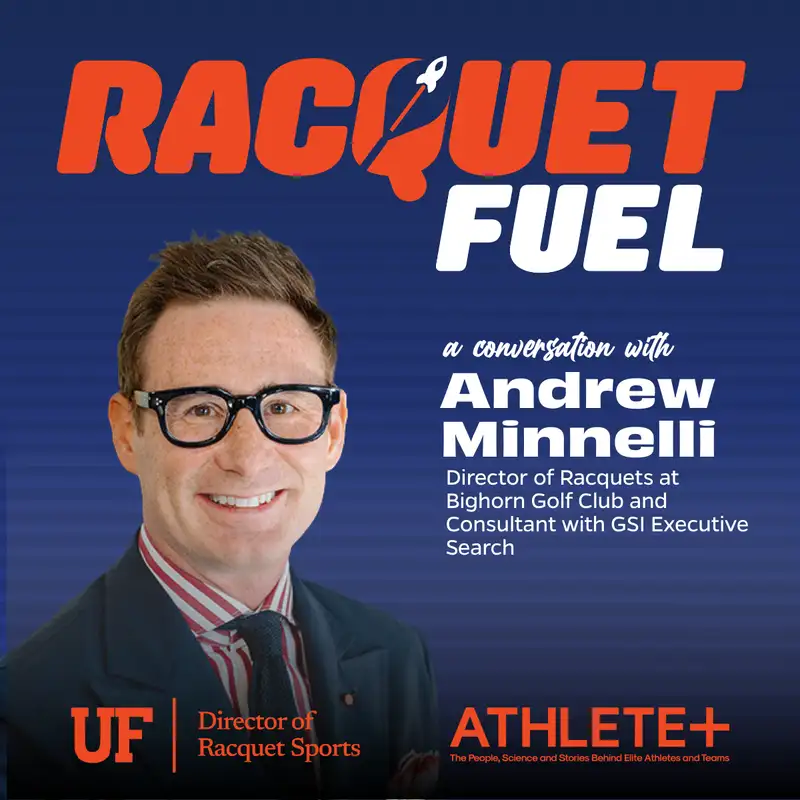
Building the Right Fit: Hiring, Leadership & Balance in Modern Racquet Clubs — with Andrew Minnelli
Welcome to Racquet Fuel, where we launch into great conversations and share powerful tools to help you become a stronger Racquet's leader. Your hosts are Kim Bastable, a former All American tennis player and now the director of professional rackets management at the University of Florida. And Simon Gale, the USTA senior director of racket sports development. Today on Racquet Fuel, a chat with search firm executive Andrew Minnelli. He shares how to prepare for the search if you want to be a director of Racquet Sports.
Episode Narration:Here are Kim and Simon.
Kim Bastable:Welcome to Racquet Fuel. I'm Kim Bastable. Here today with Simon and someone that we find very interesting, Andrew Minnelli. He has two jobs. We're gonna get a little bit of, explanation of how he pulls that off because one of them is director at Bighorn in Palm Desert, and then the other is with GSI Executive Search.
Kim Bastable:He is working with them to help clubs find new fill jobs as well as working with people in our industry to further their careers and and get put in those positions. So the search field was not something that many of us had ever heard much about in Racquet's maybe ten, twenty, maybe more like twenty, thirty years ago. It's a very important has a very holds a very important place in in the industry now. I I know you're gonna offer a lot of insights, and and, Simon, you've known Andrew from way back.
Simon Gale:About fifteen years ago, we were just talking about it before we went live here when he was at Riviera Country Club in LA. He didn't get me on the golf course, which was very disappointing, but he didn't know me at that time. That's where I'd first met him. Now I'd asked more golf favors of him, but we're excited to talk about it. It's a fascinating dual role, but a lot of respect for what Andrew does and looking forward to the conversation.
Simon Gale:So, Andrew, welcome.
Andrew Minelli:Thank you. Pleasure to be here and and be on with you both and, again, whatever I can do for the industry.
Simon Gale:Well, you have a a unique kind of split role where you work in this executive search position while also running a a Racquet's program there at Bighorn. How does this kind of come about? And the question Kim and I also had was how do you balance it all? Because I know family's a priority for you. How do you balance it all throughout the year?
Simon Gale:So explain a little bit about that.
Andrew Minelli:How it kinda came about, you know, the dual role, I wasn't really searching for any of that. It just kind of happened per se. I was the director of tennis the Seattle Tennis Club and was in transition. My wife is in the medical field and and joined a private practice in the desert, and I was actually in transition myself, and this is around 2019. And we're I'm loving it down here in the desert.
Andrew Minelli:Great weather. Figured I would, you know, figure out life and and land somewhere at some point. And then all of a sudden, COVID hits. The world shuts down. You know, I don't know whether it's just more friendships or people actually respected me.
Andrew Minelli:We'll see we'll see on that long term, but, you know, I started getting phone calls around the country from pros going, Andrew, I just got furloughed. I just got fired. What do I do? And I go, why are like, why are you calling the guy without a job? You know?
Andrew Minelli:You know? I mean, flattering, but, you know, what's why? You know? I'm I'm figuring out how to train my puppy, you know, type of thing. And it almost turned into a lesson book of career counseling.
Andrew Minelli:And, Simon, you had mentioned Riviera Country Club. GSI executive search actually vetted me on the back end for my job at Riviera Country Club when I was there. So I called them up. I said, hey. Here's what I'm doing.
Andrew Minelli:Can I maybe can I intern for you? And they go, Andrew, we don't need an intern. Let's look at maybe you being our Racquet's consultant and joining the firm. And so I had that conversation with them. Obviously, the history there, it was a it was a great fit.
Andrew Minelli:You know, an unbelievable group of consultants and colleagues in that firm, all Platinum Club general managers, former general managers for the most part. So we've got, you know, unbelievable resources, and, you know, they really wanted to carve out more of that business. And this is back in, you know, 2019, So that actually came first before Bighorn, and I started diving into that. A lot of the skills that I bring to that is it maybe it's more learned through mistakes over career, maybe a couple positive things, but a lot of things along the way and learning from others and, you know, going through a lot of interviews as well. And then later on, this was the early two thousands, Bighorn Golf Club opened up.
Andrew Minelli:And, you know, I think it's in my DNA that, really, I'm a I'm a tennis purist, you know, and and now more Racquets as well because everything is so much fun. And I really had that urge to get back within a community and not necessarily lead it, but be part of it because that was missing. And I I called them up. I hunted them down. And, you know, why isn't this GM calling me back and and all of that?
Andrew Minelli:But had that conversation with them. You know, it is we're very boutique. We're all about quality. It's not about necessarily quantity there. So there's you know, it's not not part time in any sense.
Andrew Minelli:You know, we go strong for eight months out of the year. I also have that balance where, you know, our members our members would rather, you know, go to the steakhouse in the evening than take a tennis lesson. You know? And that's that's just where we're different. That's our club.
Andrew Minelli:So I'm able to pick up my kids up at school, have dinner at a normal hour, and then GSI coexist very naturally, you know, within all of that. I do that year round. So the that's the dual role. And, again, yes, very unique. Didn't set out to do both.
Andrew Minelli:Kinda happened, and I'm really lucky.
Simon Gale:So how do you feel that you see the Racquet's industry differently kind of coexisting in these these worlds? You're in this interview and search process, but you also live it daily. How do they complement, or what do you see differently?
Andrew Minelli:Yeah. I think, you know, having the dual role, I'm I might be focused more on consequences because I'm looking at decisions that are focused on outcomes from both sides and having sat on the director role. And, you know, we sometimes we have to make decisions that aren't popular, and, you know, you gotta figure out what consequences might come from that, but what's best for the community. And, you know, and also in search, if you make the wrong decision, culture fit, where is that club going, you know, where is that pro in their career, you know, that can cost them time, money, you know, and that can also cost a lot of progress as our Racquet's industry is evolving. You wanna make sure that every club that you're you're working with maybe more on a mission based is not only staying up with that, but, you know, creating the trends.
Andrew Minelli:So it's important to to look at both, but, I'm more consequence based, you know, on that and go, okay. What's a good fit and what happens if if this doesn't work? You know? Because it it's the GSI name on the line as well as mine. You know?
Andrew Minelli:So if if we if we make a bad hire, that's on us. You know? And we take good pride in in making sure that it's done right.
Kim Bastable:So from the GSI search firm point of view, you've had a view of interviewing for these. I pry guess it's primarily directors roles that you manage, or are there other roles as well?
Andrew Minelli:Yeah. Primarily directors roles, but we've done head pro positions as well. You know? And and I'll I'll say this, you know, we're not just your platinum club, you know, although maybe we're I'm doing one at the moment, but I've done public facilities. There there are important jobs everywhere in the industry, and and, you know, we don't we don't say no to that.
Andrew Minelli:It's all about again, I'll say this. It's not work. It's fun because we're helping a facility that's, you know, deserving of somebody great, and I think our industry is family. It really is. We all have to look out for each other, and it's fine it's it's great to find a deserving pro that can put food on the table and and be at a club hopefully for long term.
Kim Bastable:Yeah. That's that's great. So how do you go about identifying this you know, what skills are you seeing are in demand, and maybe how have that has that changed in five years? What have you seen that's you know, could have been way different. We're talking early COVID or before COVID, and now it's up today.
Andrew Minelli:COVID changed the industry, didn't it? And, I mean, you know, the world shuts down, and then clubs have to reimagine what operations is like. And, you know, just aside from Racquet's, how does food and beverage survive? Are they gonna do food delivery? And I remember that whole toilet paper crisis and all that.
Andrew Minelli:Where do you find that? And clubs are stocking up and, you know, Bighorn, they would deliver things to homes and to make sure that you felt taken care of in time like that. So, you know, it really changed the industry. This is kinda goes without saying, but more and more director of tennis positions, they are fairly extinct. So more more people have to engage with the other racket sports or court sports and have a good understanding of it, have some street credit there, and bring energy and passion to that.
Andrew Minelli:And I think, you know, when I'm looking at candidates to your question there, Kim, I think probably one of the biggest mistakes that I see with with pros is they lead with certifications. And I and I don't wanna say that they're not valuable. It shows that you're investing yourself. But when you have this long line of certifications, a search committee you know, let's just say a search firm isn't involved in that, and a search committee is looking at all these acronyms, and and they don't really know what that is. It could be a little a little bit of a disguise of what is what's the shortfall there?
Andrew Minelli:You know? What what is all that, and what does that mean for me? So I think, you know, the most successful candidates that I've seen, they lead with passion and energy. And, you know, I I I think it's really comes down to more of a culture fit than did you tick off every single box on these certifications. And, again, I wanna be clear.
Andrew Minelli:Certifications are important. We have to keep investing in ourselves to make ourselves better. There's no point reinventing the wheel. Learn from one another. But it's when you're in those interviews and when you're when you're how do you see yourself within a community?
Andrew Minelli:Because every community is different. Does your energy and does your passion, does that mesh well? And will that be a long term fit? Because you don't want it to be a short term fit. We have a lot of stops in the career.
Simon Gale:So I would agree. I think the assumption is that you're certified. And hopefully during the screening process, that's been weeded out that we're interviewing you because you have appropriate certifications if that was required. Where do and you kind of answered this question a little bit. Where do a lot of candidates fall short in the interviews?
Simon Gale:What I'm hearing is is it sounds like your ability to probably tell stories of of what you've done and and your achievements and your demonstration of your passion for people and connection, all these buzzwords that you would connect in an interview. What is something you wish more candidates understood about that process?
Andrew Minelli:I I've seen this quite a bit where we all have great ideas, and we have great ideas because we've learned from other pros. And and, you know, Simon, we talked about our relationship. I remember when you came out to Southern California to do the USPTA conference, you know, back back in the day. Was think it was, like, 02/2013. I'm learning from you on how how did you set up your red, orange, green dot ball in New York and how phenomenal that was.
Andrew Minelli:I think when when and that was great for me. I was able to adapt some of that stuff. But I think where where pros kinda fall short is they'll come in with great ideas, but they don't necessarily it's it's tough for a candidate to know where somebody is as a club, you know, in their journey. And, again, there's a lot of commonalities between clubs, but there's a lot of differences as well. So I think when you come in, you go, alright.
Andrew Minelli:Here's my x y z plan. Here's my blueprint. This is what I'm gonna do. It's not really adaptable to every single problem. So I think when you come in with these set ideas and I, you know, I can even share an example when I was in Atlanta.
Andrew Minelli:But when you come up with these set ideas, it might might lose you the job because that's not a buzzword for them. And and I'll again, I'll throw myself under the bus. In Atlanta, I was there in my career for, I'd say, probably ten plus years, and it's a it is an awesome community of tennis pros and Racquet's pros. And every single club has a Pro Am, and it's their crown jewel event, and it's fun. And we all we would all rotate around and playing each other's Pro Ams and and have fun with that.
Andrew Minelli:And I I was afforded a a position with the Atlanta Athletic Club. They did not have a pro am there. And I was like, guys, we gotta do a pro am. I got a committee together. We we we built this pro am, and we had a member that that had a worthy charity and a cause that that we paired with it, and and we made it happen.
Andrew Minelli:But when I look back on that, I think that was more my agenda than the memberships. And, you know, after I had left and I had gone to Riviera, you know, I'm looking back and my friend now is the director there at this time, Marcus Racquet. Now I'm looking back. I'm talking to him about it, and they didn't really want the prime. That was really my agenda.
Andrew Minelli:And if we made it happen, I think people had fun, but they probably could have done without that. And I think, like, learning from that story you know, again, there's maybe one mistake. But learning from that story, if you have, you know, something that you're passionate about, great. Lead with passion, but you don't have to come in with something very fine detailed and already complete that you need to give to a club because that might not mesh for that mesh with them, and you don't you don't know that. And so you might be out.
Simon Gale:Well, it's a simple my simple summary of that is what do the members want, and you need to find that out before your interview and come prepared to just talk about what they want. I always used to try and get in touch with the members at a country club, and who are the key influences that I could talk to about? What do I need to do to be successful in this role? Can I I wanna hear it from them, not come in with my own personal agenda? So, yeah, I agree.
Andrew Minelli:Kinda going off that, you know, Rod Heckleman in Northern California is a is a a good friend as well, and I got this from him a little bit early in my career where he goes you know, I was interviewing for position in Northern California. He goes, Andrew, when you go in, it's okay to say I don't know. I need to I'm I'm gonna be on a listening tour for a while. You know, I can't tell you for certain because I don't know your club intimately that way. That is not a wrong answer at all.
Andrew Minelli:You know? I think that shows that you're you're open minded, and, you come with a skill set that can cover many genres of a program and leadership and and and all of that. But you have to show that you're adaptable to whatever whatever the the most critical things are for that club. What's the low hanging fruit? And then you know?
Andrew Minelli:And and if you don't know something, it's okay to say, you know what? I don't know right now, but probably ninety days, we'll have an action plan on that.
Kim Bastable:Well, that leads me to a couple questions. One is is the search firm role to help the candidates understand the culture? I know Simon said you could go out and ask people, but if it's a private club, you you may not be able to be asking some of the members information depending on how, you know, private the club is. Is is that one of the roles? And then second thing I would say is often as a part of the search for director, there's a ninety day plan that is asked to be submitted, but that's, like you said, could be a bit risky.
Kim Bastable:How do you go out on the limb, and if you're on the wrong limb, it might it might break. So how do you recommend, or how do you counsel for that?
Andrew Minelli:Yeah. I think, you know, getting back to the search firm role, you know, a little bit of the GSI process. I'm not sure if Len and Mark are similar in this way. I'm sure that they are. But we interview the search committee.
Andrew Minelli:We interview the board. We interview staff. And we do this individually, you know, also because we wanna make certain that one voice might be not they wouldn't be drowned out in a group. And that we we have a very good understanding of what's going on with the club, where have they been, where are they going. And then from there, we can kinda build out what that that candidate profile looks like, and then we can go into what the job duties are based on what's most important for that club.
Andrew Minelli:And so as a consultant, you know, I'm gonna know exactly where they are. And, of course, we do share that with our our candidates because we wanna make certain that they are well prepared and that they know. And a lot of the things that I would say, you know, with with some of the clubs we've worked with, they don't know either where where they wanna go, and that's okay as well. And as a consultant, sure, I can give them an answer, but just what I said earlier, that might not be the right answer. So it's more about finding leadership that can be on that journey with them to figure it out.
Andrew Minelli:And in terms of that ninety day plan, you know, getting to that part of the question, yeah, we we do require that as well for, you know, our our finalists, and we want them to present it either, a, to the general manager in private or, b, you know, to the search committee. You know, we're process is little bit bespoke. It's like a blazer where it has to fit that club perfectly. You know, there's not one silver bullet way that just you know, this is that's the process, but it is robust. And that ninety day plan is is one of those things that we do every single time.
Andrew Minelli:And I I do tell Candace, look. You don't wanna be vague, but you wanna make sure that, you know, you're covering everything and that you understand all about the operations, that you spend time with your CFO or or your controller. You get to know all of your other senior department heads. You're spending one on ones with your staff. You're waking up at 5AM to, you know, groom the clay courts and under you know, get to know them.
Andrew Minelli:I think that's a win with with your your your staff there. Get to know absolutely everybody. And then, you know, figure out your influencers within the the community, learn what peak times are. And, again, from there, you can come up with, you know, an action plan. Create focus groups, you know, depending on the governance of your club.
Andrew Minelli:Are you working with a tennis committee, or are you not? You know? And and figure that out. So, again, it's be vague, not but not so vague, if that makes sense, and, you know, not so specific, but you're you're really on a listening tour. And, hopefully, by the end of that sixty to ninety days, you're compiling a list.
Andrew Minelli:You know? If you do, like, a SWOT analysis and you compile a list and go, okay. Here's our strengths, our weaknesses, and our opportunities, and our threats, everything that I've I've learned within at least ninety to a hundred days, we're gonna start to come up with a game plan of where is our journey gonna go. And I think a pro coming in and saying, this is where we're going because I've already done my homework. That might cost you the job because you have to be on your listening tour.
Andrew Minelli:You have to.
Kim Bastable:Yeah. That's good. That's good good advice. Okay. Let's switch gears a little bit.
Kim Bastable:I I see you're on the board of the International Pop Tennis Association. So, you know, we already know you have two jobs. You're on this board. How do you juggle? What's your personal organization hack, or or how do you keep it all straight?
Andrew Minelli:Good question. I don't know if I can answer that.
Simon Gale:He's working on it every day.
Andrew Minelli:That's always evolving. I think many people in the industry have heard me talk about balance a lot and how it's important and how you need to be refreshed and be there for your your family, for yourself so that way you can go to work and and you're you're there, you're present, you know, and all of that. I think balance, and, yeah, I think that's earned. I'll give you an example. You know, when I started at Bighorn, that first season, I did not take a day off that entire season.
Andrew Minelli:And, you know, because I want to, again, you know, as we just talked about, be on that listening tour. And I had that conversation with my wife. I'm gonna be there as much as I can, but this is important that I get this right, you know, and that I understand, you know, what are their needs because our club is different. It just is. And it it and it's fun, but it's it's different.
Andrew Minelli:So I think balance is earned. I think when you focus on building out the right teams and understanding culture and and building that part of it, that if you focus heavily on that, then everything else can kinda coexist. You can trust that things will work, and they they don't all the time. You still need to be visible. But when you're balancing other things, if you focus on creating that culture and staff, you know, know how to be a team and cover for each other, there's no blaming, there's no finger pointing, you know, that everybody just picks up that piece of trash, or I'm gonna cover that lesson because your kid is sick.
Andrew Minelli:You know, I think once all that works, balance can exist. And and mine is always evolving. Sure. You know, I'm on the pop tennis board. That it's such a fun sport.
Andrew Minelli:We're partners with the American Racquet Sport Association, you know, based out of Georgia. It's a networking group with GSI and Bighorn. So, you know, there's a lot of lot of fun things, and and I always take phone calls too from pros. And it's it's, hey. What's going on?
Andrew Minelli:And, you know, how can I help you? And all of that. So there's a lot that I'm juggling. And I think probably the personal hack that I would say is with all that going on, I do you know, once I've created that balance and I feel like that's earned, then I have to I have to really focus on protecting, you know, family time and drawing boundaries. And, you know, it it is hard to kinda scale back when you've worked every single day of the year, you know, like, at at or of the season at Bighorn.
Andrew Minelli:Remember my second season, I had one member that said, Andrew, where are you? You know? You know? And he's jabbing me, and and, you know, and he's he's fun. He's like my class clown of our group, and he's just awesome.
Andrew Minelli:But he's like, you take another day off? I'm like, Ted, it's Sunday. You know? If I don't take this day off, the locks on the house will be changed for sure. So it's just more about protecting boundaries and drawing that, and people think once there's a good system, they don't fault you for taking time for yourself, and you just have to do it.
Andrew Minelli:You have to.
Simon Gale:So let's shift focus to the clubs a little bit. How open are clubs to, say, a search firm or your insights regarding what it takes in this day and age with with your modern racket sports director who's maybe overseeing two or three sports and larger teams, and the demands on them are even greater. Are the clubs evolving with that? Are you in a position where you're recommending, hey. They shouldn't be on court as much.
Simon Gale:They need to be in more of a management and develop mental role developing their staff. What what are you seeing?
Andrew Minelli:Yeah. I I think clubs are receptive. I think at the end of the day too, you know, pros need to understand that you know, I've heard this a little bit, you know, from pros. Oh, you know, I don't like search firms because we feel like they're shaping how things go. We do in a sense, but I think it's it can be mission based one on one with clubs.
Andrew Minelli:Are they receptive? Absolutely. You know, is it industry wide? No. Because, you know, working with a search firm can be a luxury.
Andrew Minelli:Yes. If they hire you, I think they're open to your counsel, but, also, it's their club. And we're we're coming in. We're understanding where they've been, where they're coming from, but it's their club. It's their decision.
Andrew Minelli:So they can take our advice behind closed doors and figure out whether they wanna take it or not. And and I would say most times, it's it's heavily considered, and they do, but sometimes they say no. That's okay. But I think as consultants, and speaking for myself, if they hire us, we're gonna give them the truth. This is where we think you need to be, and and, you know, this is where this is the type of leader that you need.
Andrew Minelli:This is the candidate profile you need. And I I would say, you know, to your point about, you know, how much court time, very fortunate to do Westchester Country Club right now in in Ryan, New York and work with them. That is a very unique unique, very special club. We're building out what's on court and what's off court time, you know, versus maybe, like, another club. It's just very different.
Andrew Minelli:And this position probably you see that more as a c suite executive because they're overseeing squat, pickle, tennis, and platform. And most most of those Northeast clubs, you're gonna see more of that versus maybe your your California club where it's maybe two or three sports as we're adding paddle. But I would say just in general, you know, it really comes down to the club. Where has their director role been? And does that make sense for where they're going?
Andrew Minelli:And it again, I, you know, kind of, like, use the bespoke blazer analogy there. There's not a silver bullet on on how it should work. So I think every club, you do need to look at individually. We all have skill sets, you know, in our industry, you know, as as we're building out our leadership or brand, and hopefully, you're adaptable enough to if that's a job that you're looking for and you don't mind being on court fifteen to twenty hours a week, but still leading a staff depending on the robust operation, then you can do that. Or, you know, if you're gonna be more of that five to ten hours on court, and you're empowering your staff, and you're you're shaking hands and kissing babies, and you're learning what those peak traffic times are, you're out with the members, or razzing somebody like, you know, I would with Ted at my club.
Andrew Minelli:It's it's just being adaptable.
Kim Bastable:So I would love to take that and go to the idea of how do you sell yourself. You speak of the you have to be bespoke. Every club is different. Then I'm gonna argue every resume must be different. If you're writing a resume or writing a cover letter, the stock resume, stock cover letters, stock story of a candidate doesn't fly.
Kim Bastable:Would you agree? And how how much do you emphasize this? Even for a head pro job or some of the lower lower other positions, you can't sell your story the same way to everyone.
Andrew Minelli:Yeah. I agree. I think to your point on the resume, boy, I mean, when when you say that out loud, you're like, gosh. I have to, like, have 20 different resumes for clubs. No.
Andrew Minelli:I I don't think so. I mean, you need to have something that, number one, has metrics in it, you know, that defines what you've done in terms of growth. You can't just say, I ran ladies leagues. Well, great. Well, how many teams?
Andrew Minelli:Were they successful? And so, you know, you you have to have everything in there. Don't be shy about putting putting something in there. I think long ago, there are the days that needs this needs to fit on one page. But I think where you can sell yourself and where you can really be different is your cover letter.
Andrew Minelli:Also, looking at your digital footprint, your brand. What are you doing on your LinkedIn? Are you sharing any tips, you know, on YouTube or or social media? You know, do you need to do a lot of that? You know, that can be somewhat commercialized and self promotion, so you do do you do need to be careful.
Andrew Minelli:But it's being mindful of what do you want your brand to be and how do you create that. Have your template, you know, with your resume, but I think your cover letter can be more bespoke that hopefully speaks to where they are and how you fit in their journey.
Simon Gale:So, Andrew, we're gonna start to wrap things up a little bit here. I'm gonna ask you to summarize a little bit. What would you say is a a solid piece of advice or maybe an action item that leaders could take with them? Something you wanna leave that maybe inspires them moving forward?
Andrew Minelli:Yeah. I think for me, I look at I look at other industries in general, and I try to steal good ideas from from that. And there's one person in particular, Matt Jacobson, who's one of the founders of Facebook, works with Meta. And one thing that he says a lot is be the best part of somebody else's day. And when I hear that, I go, wow.
Andrew Minelli:That's powerful. If somebody's on the court with you, that's their hour of recreation, or they're trying to stay healthy or get better at their craft as they're, you know, on on that journey in pickleball or or pal or tennis or squash, whatever it might be. How can that stop be the best part of their day where they really look forward to coming back again this week or next week? And I think in terms of leaders, that works as well as be visible, be present, be a good listener, recognize your staff, show appreciation. And, you know, I think when you do that, you are the best part, hopefully, of your staff's day.
Andrew Minelli:We gotta remember it's not about us. It's about our team. But but just that type of presence and having that mindset and almost that early morning meditation of be the best part of somebody else's day, I think if you go into your day that way, gosh, you know, that covers so much.
Kim Bastable:I find that fascinating. I want it makes me think think about it in terms of, like, groups of people. Maybe you find a peer to make the best of their day. Find a student to make the best of their day. Find a family member to make you know?
Kim Bastable:So you just sorta hit all different types of groups. I like that as an inspiration. The other thing I mentioned that I found, the idea of value advocated for yourself to get that job at GSI. You looked outside the box and you went and asked the question, and you were looking to be an intern, and little did you know there was a different position there, but just that you reached out was probably just good timing for something maybe they were seeking, or maybe you brought up an idea they never thought of. You know, it doesn't really matter, but when you step out and ask what's the worst I can say is, no, no.
Kim Bastable:And I love that idea. I've done that many times myself. In fact, that's how I got into the job at UF, so I'm all about that advocation thing. Simon, what's your takeaway?
Simon Gale:Yeah. I think we continue to see a theme of people on their journeys into leadership, the connections they make along the way always seem to come back and help them at some point. And it might be completely innocent connection, but at some point, you reconnect and they help you. So I I think the importance of that networking comes through really understanding what a club or facility wants versus what your personal agenda is and what worked at other facilities, being able to personalize it, so to speak, for what the club needs. And I really like when you said balance is earned, the ability to work hard and then reap the rewards and enjoy working at a facility long term.
Simon Gale:You've earned that, and I think then you're afforded more balance as you go along. So very insightful, mate, and I appreciate your thoughts today.
Andrew Minelli:The other thing I'd say, you know, balance is earned, and build loyalty with your membership. I think the other thing that we look at with resumes is employment dates, logical progression, and and stable tenure. And that doesn't mean that, you know, you can't leave a position in two years and get, you know, something else. But I think that, you know, if you can stay put where you are and build that loyalty, and there's gonna be some storms that come your way, how do you navigate that? How do you embrace that storm in that tough challenging time?
Andrew Minelli:Members will notice, And I think that when they notice and and you're there and you're present and you're listening, they appreciate that. And you've built you've built some loyalty there, and, hopefully, that's a as a situation where a pro is, we don't ever wanna see that person go, you know, if a member's saying that. And I I just think that's so important. And and when you look at when you look at a resume where somebody's been somewhere ten plus years, very stable. And more and more clubs would find that attractive because, hopefully, they would see that person at their club for that long as well.
Kim Bastable:Very good advice. Love that. Well said. Thank you very much for your time, insights, coaching for for those who are listening to the podcast. We appreciate it.
Kim Bastable:Alright. That's what we have for you today on Racquet Fuel, and I think we should all go make someone else's day better. Have a great day.
Episode Narration:That's all for today, but we're not out of fuel. You can find more information and resources in our show notes and by visiting racketfuelpodcast.com. If you liked what you just heard, please subscribe. And also, leave a review, which helps other people join the mission to become stronger Racquet's leaders.
Kim Bastable:If today's conversation sparked something for you and you're looking to keep growing as a Racquet's professional, UF would love to support you. Our listeners can take $100 off our director of Racquet Sports curriculum course one with the code r f 100 or $25 off our personal brand management for the rackets industry course using code r f 25. Both are built to help you grow as a leader and create your next opportunity in the industry. You can learn more and enroll at www.uf-dors.com.
Conclusion:This podcast is a production of athlete plus, the people, stories, science behind elite athletes and teams. Athlete Plus is the official podcast network of the Institute for Coaching Excellence, a research, education, and outreach center in the College of Health and Human Performance at the University of Florida. The Institute for Coaching Excellence offers various online certificate programs and degrees in partnership with the Department of Sport Management. Learn more today at coaching.hhp.ufl.edu.