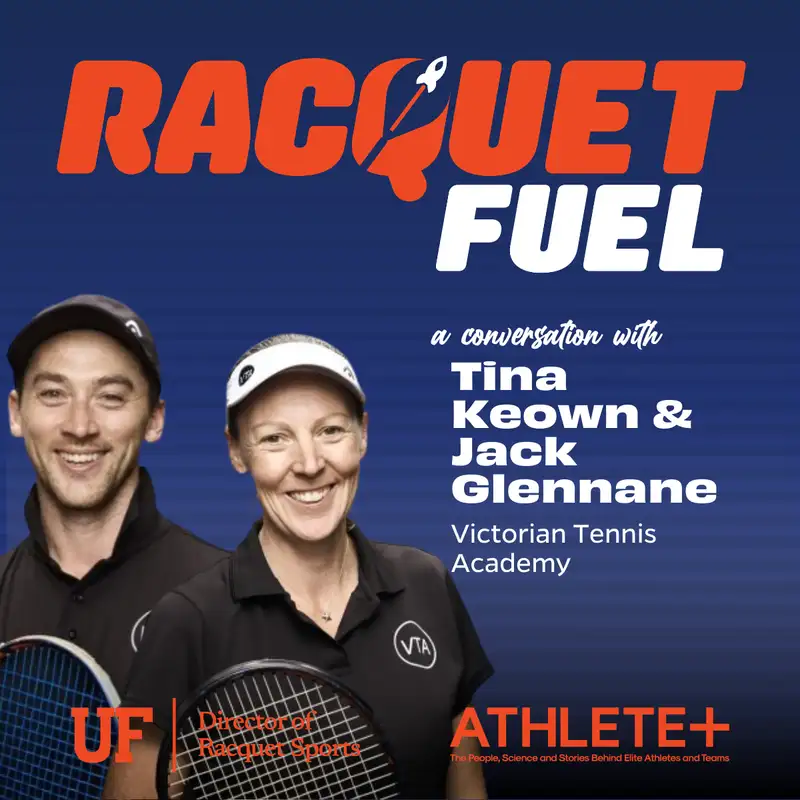
Building a Sustainable Tennis Business: Lessons from Australia’s Victorian Tennis Academy - Tina Keown & Jack Glennane
Welcome to Racquet Fuel, where we launch into great conversations and share powerful tools to help you become a stronger Racquet's leader. Your hosts are Kim Bastable, a former All American Tennis player and now the director of professional rackets management at the University of Florida. And Simon Gale, the USTA senior director of Racquet Sports Development. Today on Racquet Fuel, Tina Keown and Jack Glennane are coming to us from Down Under. They are two Aussie coaches who have now become business owners.
Episode Narration:Kim and Simon ask what we have in common with club operations there and learn what has worked in Australia for leadership success. Here are Kim and Simon.
Kim Bastable:Welcome to Racquet Fuel. I'm Kim Bastival here with my Aussie cohost, Simon, who's brought some of his Aussie friends with him. We are going to Melbourne, Australia, and we're checking out the Victorian Tennis Academy. This is one of Victoria and Australia's top tennis organizations, won multiple Tennis Australia awards. It's run by Tina Key Wynn and Jack Glennane, a dynamic duo who not only coach but also manage multiple venues and programs.
Kim Bastable:We're gonna go behind the scenes, learn from how they attract and keep great coaches, streamline their operations, and stay focused on what really matters to a successful tennis academy, which as we've discussed is somewhat similar to America, not exactly. Simon?
Simon Gale:Yeah. Look. I met Tina and Jack last year when I was in Australia and and got to spend a couple of days with their business and learned a lot, and and we shared a lot of commonalities and pain points that we all deal with as owners, operators, managers. So I'm really excited to to compare and contrast with some of the things we do here in The States and just hear their story. I think it's really interesting.
Simon Gale:So welcome, you two. Thanks for joining us.
Tina Keown:Thanks for having us.
Jack Glennane:Thanks for having us, guys.
Kim Bastable:So I have loved Australian tennis since I was a child. I mean, I grew up in the days of nuke and labor, and we are recording this during that happy slam down under, and it looks like a lot of fun and a little bit of heat. You guys do have quite a hot winter, as we would say, but for you, it's summer. But can you give us just a a landscape of Australian tennis? Is it a big activity participation wise to the population?
Kim Bastable:And just what does your business, Victorian Tennis Academy, look like?
Tina Keown:Yeah. I'll I'll start off. So first of all, yeah, thanks to you, Kim and Simon, for, yeah, the opportunity to share our business journey in tennis. As Simon said, we had the privilege to meet and connect with him last February when he was in Melbourne, and then again when we visited The US on Tennis Australia's Top Operators Talk. So since then, he introduced us to Racquet Fuel, so we've definitely been tuning in to other podcasts.
Tina Keown:And, yeah, we're huge fans, so great to, yeah, have the opportunity to be on here. So, yeah, so as you mentioned, in the middle of the Australian Open, and every year, it seems to get bigger and bigger. The first four days of this tournament, we saw over a 100,000 people through the gate, and this is the first year that it's now a three week event. So we have opening week where we have our qualifying events, and that really is the start of the tournament. So for us at the Victorian Tennis Academy, we have four venues, and two of those venues are in the city and just walking distance from Rod Laver Arena.
Tina Keown:So we're very well positioned to, yeah, maximize participation. And, yeah, for us, it's, you know, it's court hires, it's social tennis, it's events, it's coaching at the junior and adults, beginner level right through to performance pathways. So, yeah, it's a it's a huge promotional opportunity for us being on the doorstep.
Simon Gale:So, Tina, let's start at the heart of of any tennis organization, especially successful ones, is the quality of your people. So coaches and staff really make or break the delivery and the success of your program. And I would say in general, I think this is fairly universal. We struggle as a profession and are at the moment anyway to to find and develop the next wave of coaches and especially tennis leaders. You know, there's a reason Kim has a director of racquet sports program, and we've started the apprenticeship program here.
Simon Gale:We're trying to cultivate that next wave. How do you attract quality talent to VTA? And once you have them, how do you keep them engaged and growing within your business?
Tina Keown:Yeah. Look, I think you've hit on a a global pain point there, Simon. I think finding and retaining the next generation of coaches and leaders is arguably the biggest challenge in our industry. So what we've done, we've shifted our perspective to solve this not just by offering jobs, but by creating our own structured career pathway. So first and foremost, when we recruit, we recruit for values first.
Tina Keown:So our company values are service and respect, integrity and trust, and teamwork and accountability. And it's important for us that our team has values that align with that of the company, because we believe we can train people to deliver our product, but we can't teach character. So once we get the right people on board, we keep them by developing individual career paths and by investing in professional development. So, on the back of the recent US trip and the work that we did with you, Simon, when you were in Melbourne, we've gone ahead and created our own seven tier VTA career pathway, and this framework has a clear trajectory that takes someone from an assistant future leader at, say, a tier one level, right through to a VTA senior manager or director of coaching at tier seven. And yeah, I guess we support that by focusing on three different pillars.
Tina Keown:So we have the on court professional development, where we provide internal and external coaching workshops to help help the coaches unlock their technical potential. We also have the off court professional development, so we train in business acumen, ensuring our team understands the why behind the operations. And then we look for team members with business potential or leadership. So for those with ambition, we offer more mentoring, and we've recently introduced executive coaching as well. So I think that framework has definitely helped our structure to keep people in the business.
Simon Gale:Yeah. Well, you know I love pathways, so I love hearing that, and and I'm fascinated to hear how it's gone. So, Jack, from an operational side, which is where you tend to focus a lot of your energy within the business, Two questions, actually. Just quick. How have you how have you found that pathway is is working for you, but then how do you ensure that that you have the tools and environment for people to thrive?
Jack Glennane:Yeah. I mean, I think, yeah, Tina's kind of spot on here with how we're working to keep the team kind of engaged and growing. And I think since we've we've kind of started that work on the pathway and the career development for everyone, yeah, we've seen a massive shift in VTA just stepping up a a level. And I think over the next year, two years, like, that's only gonna expand more and and our attention is gonna, yeah, increase because of that. From an operational side, yeah, I think I think just creating the environment is key.
Jack Glennane:So, yeah, recognizing that a business like ours is is more than just hitting tennis balls. We want everyone in the team to have an area they own and just know that there's there's an opportunity for them to to grow more than, yeah, just kinda simply coaching. Yeah. I guess we wanna keep our people for the the long run rather than kind of maxing them out with with hitting balls.
Kim Bastable:That's such an exceptional thing that you offer executive coaching. I don't think I've ever heard of a tennis club doing that. Is that something you offer at a certain leadership level or to anyone?
Jack Glennane:I mean, it's it started off with ourselves, and I I think Tina and I recognize how beneficial it was and how much we were able to grow because of it. And, yeah, I mean, my biggest learning from all the development that we've done is that, yeah, I I we wanted to provide that for our team also. So, I mean, in terms of the exec coaching, like, we we provide that for our management team.
Simon Gale:Yeah. How's your team responded to that? What's the feedback been? Are they do do you see a noticeable engagement uptick? Do you see
Kim Bastable:Or do you see resistance, which I'm wondering?
Simon Gale:What do you see?
Jack Glennane:I think so far it's been overwhelmingly positive. I think they recognize that not all tennis business businesses make that investment in terms of time and and money. So I think they definitely value that side of things. I guess time will tell. I think it's more of a longer a longer burn with some of the exec coaching.
Kim Bastable:Yeah. You can't you can't fix your forehand overnight, and executive coaching kinda the same way. So a little bit of long term vision, and that's exciting, though. Well, that kinda goes into the next question, which is you two are partners in leadership. I know you have a silent partner as well who is also a part of your team, but how do you two have roles and responsibilities divided?
Kim Bastable:You know, what's it look like behind the scenes, and how do you navigate through any overlap or disagreements?
Tina Keown:And, yeah, I think that's a really interesting question and quite funny because we quite recently, we did a deep dive into our own operational styles and found out that we're basically opposites. So I'm what you call a classic peacock, which is a natural connector. I love to have big networks and bounce ideas off people. I also cross over into some eagle tendencies, which is more of the driver. And because of that, I'm always looking to get things done.
Tina Keown:I have high energy and, yeah, like to keep things moving. Whereas Jack leans more towards the dove and the owl operational style. So he's more task orientated and analytical. So, yeah, so whilst I'm flying at a 100 miles per hour, Jack is the master of the how and the strategy and facts and figures, and I guess the important detail, yeah, to ensure that, yeah, the actual ideas, yeah, work at forefront. So, yeah, we're both very different, but I think, yeah, we've been successful because we both complement each other very well.
Kim Bastable:Yeah. Mean answer the disagreements part. So maybe you've had a few of those.
Jack Glennane:I mean, yeah, as Tina said, I think that, yeah, we we balance each other and we complement each other pretty well. So for the most of the time, we we do agree and we are aligned on most most things, which is which is great. Yeah. I mean, you definitely wouldn't want too many peacocks leading the business or too many doves. But, yeah, we do disagree.
Jack Glennane:And, yeah, I think we both agree that disagreement is is healthy. It's a healthy part of a business relationship because, yeah, ultimately, it helps us get the best result for the business. I think with with disagreements, we're always respectful. We're always open to learning, and we always try and work through kind of the challenges. But, yeah, we are we are lucky that we agree a lot.
Tina Keown:Yeah. And I think, yeah, Jack's right. That level of respect, I think, yeah, neither of us could run this successful business solo. You know, I think we are successful because, yeah, we have each other and obviously our our other business partner, Rick Foley as well. So, yeah, I think, yeah, as long as yeah.
Tina Keown:We all we all know that. We all realise. So, yeah, those arguments, yeah, can be healthy as well.
Simon Gale:Well, you two are true owner operators. You you obviously own the business, but I know you're very hands on from a coaching and operations point of view. What what would you say is the biggest challenge? I'm sure you give me a long list of challenges too, but what's the one of the biggest challenges in wearing both that leadership and operational hat every day, six or seven days a week?
Tina Keown:Yeah. I think the biggest challenge isn't definitely not letting the the urgent get in way of the importance. So as an owner operator, yeah, with the the operational hat often tries to take us back down to the doing of the tasks, so dealing with schedules or a conflict or a facility issue, instead of staying focused on the bigger picture and business strategy at a higher level. So I've had to learn that I think my most important operational task is actually empowering the team. So making sure I stay connected with the same vision and ensure that we provide the necessary support, training and opportunity, yeah, to elevate individuals so that we can continue to keep performing or create a high performing team.
Tina Keown:And I think a good example of that is, yeah, making sure we commit to our monthly one on one check ins and don't let the operational tasks get in the way of making sure we meet those commitments.
Simon Gale:And, Jack, how do you stay focused on key priorities of the business while managing day to day coaching and operations?
Jack Glennane:It's a good question. It's it's yeah. It's not it's not easy, and and I think it's one that we've slowly improved in over time. But, yeah, I I I'd say kind of, yeah, if we can bring everyone on the journey, so it's not just Tina and I driving business. Like, we've got we've got a whole team of people who are kind of driving VTA forwards to help us achieve the goals of the business, and, like, we do have an amazing team.
Jack Glennane:I think the creating a structure so we've worked really hard to create a current business structure. So the roles within the business, as Tina mentioned, over the career pathway, so people can can develop, can progress, they can have ownership of areas, and they're empowered to drive the business business forwards. I think in the past, we've we've probably made the mistake of thinking that we have to be everything to everyone rather than, yeah, empowering others, and it just doesn't allow you to kind of focus on the the the stuff you need to do to keep the business running.
Simon Gale:Well, it it really sounds like I don't remember how long you guys have been in the business, but it's quite a while now, I think. And you it feels like you guys have evolved a lot, and especially in the last few years, for example. How comfortable do you feel calling yourself owner operators and feeling like you've I don't think we have a master running these businesses, but where you feel like you're quite comfortable in your own skin with being what you are compared to what you were when you started.
Tina Keown:Yeah. So I've been in the business for, yeah, twenty five years. So twenty five years at the Victorian Tennis Academy. Started as a casual coach, then moved into, yeah, a full time senior coaching role, then moved into a management role, and then had an opportunity, yeah, to move into, yeah, being a director. So Jack and I have both been directors for about eight years now.
Tina Keown:But I think, yeah, definitely at the start, there's a lot of learning. It's a different landscape, especially from the leadership piece. So, yeah, we've had to learn a lot along the way. But, yeah, most recently, especially last year, we both did a lot of investment in our own growth and learning at more of that business director executive coaching area. So that's definitely helped give us the confidence to call ourselves real directors or owners.
Tina Keown:But, yeah, it's been a journey, and it's probably only within the last couple of years that we feel comfortable in our shoes now.
Simon Gale:And Jack, you feel the same way?
Jack Glennane:Yeah. I yeah. I mean, I similarly to Tina, kind of yeah. I'd I'd started off as a casual coach fifteen years ago. I progressed, yeah, senior coach, head coach.
Jack Glennane:The role of director was kind of is always something that I wanted, but, yeah, it was thrown upon me. And I have learnt or learnt very quickly of, yeah, how to deal with things. But, yeah, it's it's I mean, question, am I am I comfortable? I think I'm evolving as a leader, as a director. I think having gone through that kind of journey in the business, I always still have a tendency to I wanna kind of get in and support and and help in that kind of the team and the operational level.
Jack Glennane:So I've just gotta, yeah, keep reminding myself of, yeah, the focus for me as a director, I think.
Kim Bastable:I love the honesty there and the and the bit of a I won't say lack of confidence because to me, you have confidence, but I think the unsure nature of of being put into a leadership role, I think that's something everyone who gets moved into a role kinda wonders whether they have have the elements to do it and do it well. That's an interesting like you said, and many I think many directors are placed into it rather suddenly someone left and, oh, you're here. You'll be the next direct. There's no thought to whether they're actually qualified for that new role. So give us just a glimpse because we really didn't overview fully.
Kim Bastable:I look at your website, and I'm quite impressed as to how well you lay it all out. But multiple locations, how many courts do you oversee? How many? How far apart are these locations? Give us a little bit of a glimpse.
Kim Bastable:Like and then with that, how your names are on multiple website low like, multiple locate like, you teach at multiple places. I don't think you're located at one club each of you. So your day to day, what's that look like?
Jack Glennane:Yeah. In term in terms of the structure, so we've we we have four venues. So four kind of large centrally located venues in Melbourne. They're not a huge distance apart, I'd say, yeah, between twenty to forty five minutes, like, distance from each other. Yeah.
Jack Glennane:In terms of how we how we manage it, yeah, we're like, we we are across multiple venues, but we are one business. So, yeah, we we do have that really strong shared vision, the shared values, the shared goals. We're just we're just spread across multiple venues.
Kim Bastable:How many how many courts total?
Jack Glennane:We have 24. 24.
Tina Keown:Yeah. So 24 synthetic grass courts, and, yeah, pretty much Jack sort of oversees two venues, and I oversee two venues, and then we constantly come together to, yeah, collaborate. We have three venue managers, so we have a weekly check-in on a Monday morning with the venue managers and directors just to make sure that, again, we further align in the business, and we have that really clear communication of what's happening at one venue or another venue. We quite often share staff over a couple of venues as well, so yeah, it's really important that, yeah, that level of communication is frequent. It's transparent.
Tina Keown:Everybody's talking weekly. Everybody's on the same page. And I guess that helps us with their support. That helps us oversee all four locations.
Kim Bastable:And you're on the court. Tell me a little bit about how often, how many hours are each of you on the court still?
Jack Glennane:Not as many as we used to be. I mean, up until a couple of years ago, we were coaching twenty twenty plus hours a week.
Tina Keown:Up until we, yeah, met with Simon last year in February, and he played it out on the the table, what a what a clear director's role should look like.
Simon Gale:That's kind of leads into my my next question. It's like sometimes you get so caught up in running your business, you know, that you just get used to doing things a certain way. Right? And and sometimes you need someone I know you've had multiple people over the last couple of years kinda become involved a little bit to with some some guidance and so on. Someone needs to just say, hey.
Simon Gale:Maybe you should look at it this way, and and it takes that to change your habits. We're all guilty of it. We do things a certain way, but somebody's gonna say, hey. Look at it this way. And you say, oh, I never thought of it that way.
Simon Gale:So, hey. I'm just glad you actually listened to me, which is very rare in most people in my life, so I appreciate you guys taking taking the advice. But when you look back at your your leadership role here and what are some of the big lessons you've learned about balancing people, programs, business growth, operations? What what are your big takeaways over the years? Tina, why don't you start for us?
Tina Keown:Yeah. Look, I think, yeah, one of the biggest lessons I've learned is really you're only ever as good as your people, and yeah, I guess it can sound like a bit of a cliche, but we're really, like, we're in the service based industry, so I think, yeah, we've spoken a lot about, you know, we love to invest in our people, so whether that's through the seven tier career pathway or through professional development. Yeah, we really want our team to feel valued and empowered. And I think that when they do feel that, and they feel that they have a future with your company, or with their brand, then they don't just do their jobs, but they authentically look after your clients. So, yeah, I think, yeah, you're only ever as good as your people.
Tina Keown:And yeah, recently, just at the coaching conference at the Australian Open, there was a powerful statistic that said one returning customer is the equivalent of 10 casual players. Like, the truth in that is you can have multiple marketing campaigns, but you can re you really reach those true customers through meaningful relationships.
Jack Glennane:Yeah. I think I think Tina's kind of nailed it with with people. Yeah. I think investing investing in people, looking after people, retaining people, it's it's a key. Yeah.
Jack Glennane:It's it's a real focus for us.
Kim Bastable:Well, let's speak to that just a little bit. I have a different question, but I'm curious. What does that look like in Australia? Do you have certification? Do you have conferences?
Kim Bastable:Do you have consultants that come in and teach certain teaching styles? Or what does that look like for investing in in maybe your coaches?
Jack Glennane:So we in terms of our team, we we've moved to a model, like an employment based model. I think one of the the biggest challenges in the tennis industry is that it's actually really tough. But, yeah, for most coaches, hours are on social. Like, you work evenings. You work weekends.
Jack Glennane:Like, it's it's pretty casualized workforce. Coaches are paid by the hour. Like, they're affected by rain, heat, cancellations. It's a really tough industry to build a career, like a long term career. So we've moved towards a business model where, yeah, we we have salaried employees.
Jack Glennane:We wanna create opportunities for anyone within our business to move to that full time kind of permanent staff member. They have a balance, so they work they have an option to work a five day week. Yeah. And we we kind of feel that that really helps retain our people. I think, yeah, we we've observed I think Tina mentioned earlier that we don't lose our coaches or people to other tennis clubs, typically.
Jack Glennane:Like, we're losing them to other industries because they reach a point where they, yeah, they wanna have a more balance. They wanna have more security. They wanna have guaranteed income and holiday pay and and and these things. So, yeah, I think I think for us, that's that's been the biggest shift over the last five years.
Kim Bastable:Yeah. That's good. And that doesn't sound dissimilar from what's happening in America. Would you have some advice to the The US owners, or would you say that type of maybe that move toward salaries? Or what would you say is the advice of what you've learned about how you build that sustainable team?
Kim Bastable:Maybe it's your career path. I don't know. What's the what's the trick for you?
Jack Glennane:It's it's challenging. We've worked really hard to have, like, a really diverse program. So I guess we don't just focus on one one area. Like, it's not just junior coaching. Like, we the academy has has everything.
Jack Glennane:So it's adult comps, junior comps, court hires, pro shop, restringing. Like, there's all these different areas where people can get involved, but it it helps us facilitate those schedules. So it's not dependent on just coaching a nighttime or coaching a Saturday. Like, it's so, yeah, I think my point is, yeah, having that diversity in your programs and your offering, yeah, really allows you to to make these these changes.
Simon Gale:Do you guys feel like you know, it feels like it's a collection of things you talked about, work week, balance, education, investment pathway. There's a lot of pieces there. Do you feel like you're at a point now where when you sell this to a potential hire or you sell it to your existing staff, it's something that resonates or sticks or stands out because it's a little different than what's out there? I find that here with the clubs that can sell those things collectively that they're a little different than places that don't and and kind of run it the way we've always run tennis. Do you do you notice that, Tina, for example, when you when you have these conversations?
Tina Keown:Yeah. Look. I think it's definitely it's like a selling point for us. So when we're advertising or we're looking for new coaches, we definitely present that this is what we can offer as a starting point, and we have a career path, and this is what it might look like now, and this is what we can work towards. And I think that we've created that because we've gone through all the problems, all the issues in the past where coaches have been burnt out because they're coaching or delivering thirty eight hours.
Tina Keown:So most of our heads of coaching or senior coaching, we maximize that's a thirty hour on court week, and they get eight hours to do some planning or to work on a social tournament or an event or something off court, so I think we've got to this point because we've learned over the last three to five years what has been driving people away from the sport. Like the five day work week, that's very uncommon traditionally in our industry, so we've worked hard to create the business and the volume so that coaches can do a five day work week. So yeah, think it's a lot of learnings, and yeah, we're always listening to our team and taking the feedback on how we can make their work life balance as most suitable for their lifestyle as we can. And, Jack and I are very people focused, so it's great that, you know, we're always gonna be on the same page with that, and we come up with different options. But yeah, regarding the certifications, yeah, we promote a lot of our coaches to go through the TA courses.
Tina Keown:We recently just had the Australian Open Coaching Conference, and we supported 16 of our team members to go for a day, which was great. I think we had six or seven on Monday and another six or seven, so as well as going to the conference and learning from other international industry leaders, they're also going in small teams, so it's social and it's fun, and they can do something different with each other, and we had, I think we also had seven of our female coaches attend one of our Women and Girls Coach Connect conferences. So, yeah, having 22 coaches go and participate in the Australian Open Conference is something that, yeah, Jack and I are really proud to be able to do for our team.
Simon Gale:Yeah. I think that's great. You guys should be. I think I mean, it helps that you can walk to the venue as well. That makes it Yes.
Simon Gale:More affordable. That's one of the benefits of working where you work. So as we start to wrap things up here, if you could, for us, just maybe, Jack, first, one piece of advice or or a kind of message in general about, you know, what you've learned over the years or something that you would wanna leave our listeners to inspire them or or or be your final message for the day?
Jack Glennane:Yeah. Sure. Okay. Well, I haven't I haven't really delved into this too much today, but, yeah, one thing that I always believe in is is create an environment where your team can challenge each other and challenge yourself, make it respectful, keep it positive, but you'll always achieve a better outcome. So, yeah, I mean, I want my team to to challenge me if they think I'm making a bad decision.
Jack Glennane:I definitely don't wanna be surrounded by people who just say yes because it's easier or because they're afraid to say say otherwise. Asking for input, whether it's it's kind of your senior manager, a coach, someone else in your team, everyone has ideas, and, yeah, you should listen to their ideas and opinion.
Tina Keown:Yeah. If I could leave listeners with one message, I think it would be, yeah, to prioritise connection, so with your staff and with your clients. I said before that, yeah, I think industry that we're in is a customer experience industry and not just hitting tennis balls. So my action item for any, yeah, tennis operators or leaders would be to stop looking at the staff as as ball machines and, yeah, start investing in the team's personal brands. And I think that's where, yeah, we're in a privileged position to be able to help build other people's personal brands.
Kim Bastable:Excellent advice. And you've covered so many different things from your own leadership learnings and what you've learned about yourselves that makes you a better team to the fact that you hire for values first, and you can train the other things later. There's so many takeaways. Simon, do you do you have some in particular that have impressed you?
Simon Gale:Yeah. I wrote a couple down. Was don't let urgent get in the way of important. I like that one. Obviously, you're only as good as your people, which we hear a lot, but I think breaking that down to investing in them, empowering them, and showing them where they could end up or where they're headed.
Simon Gale:And I thought it was interesting when you talked about we don't lose coaches to other coaching venues. We lose them more to other industries, which is I think something we've focused on a lot, Kim, with some of our our interviews is just retaining coaches. So it sounds like you guys are doing some great things there and really enjoyed hearing your story and learning more about your successes. It just sounds like you're doing great things and and keep up the great work.
Kim Bastable:Yeah. Where do you all see yourselves in the next ten years? Are you gonna still be doing the same things? Are you growing for a new venue? What's next?
Jack Glennane:That's a tough question.
Tina Keown:That is a tough question. I think I'd rather go three to five years than than the big 10. We'd start small. But, no, I think Jack and I's goal in that short term, maybe one to three years, is, yeah, keep trying to elevate ourselves into that true director's role. We're probably at sort of the general manager's position at the moment, so, yeah, the more we can invest in in, yeah, the team to keep building the team up, hopefully, it'll keep elevating Jack and I, yeah, into that true director's role, which, yeah, just gives us more time, yeah, to focus on the business, not in the business.
Tina Keown:And, yeah, that's a guess when all the the new creative ideas, yeah, will come.
Jack Glennane:Yeah. I think we're we're focused on doing what we currently do better all the time rather than looking at the moment for that next that next expansion.
Kim Bastable:Yeah. And which I think is an excellent way to look at it. I don't know that everybody needs to to build, build, build, so the point that they have so many different locations, it sounds like you have a great thing going. And as I said from the website, which is what we can see from this far away, it's quite impressive. So we appreciate your time and how you've shared so honestly about what you're doing down there.
Kim Bastable:We we love the idea that Australian tennis rises up and continues to grow. And I'm sure every January, we're always reflecting upon what's happening down under. Perhaps we can revisit and see see how things change because I do think it's a quite a good education for for Americans to see see it from a different venue. So thank you both for for your time, your expertise, and good luck. Thanks, guys.
Tina Keown:Yeah. No. Thanks for having us. Yeah. Make sure you Melbourne on your bucket list, Kim.
Tina Keown:We'd love to host both you and Simon over here one year for the Australian Open, so stay tuned.
Kim Bastable:I think I could talk my husband into that. So thanks, Simon, for making this connection.
Simon Gale:No. Thanks so much, you guys. Really appreciate your honesty, as Kim said, and and, look forward to connecting in Australia again at some point soon. Looking forward to it.
Kim Bastable:We are very happy to, have you there, and we appreciate your time as listeners to, be with us today on Racquet Fuel. We're excited to have taken you down under during the Happy Slam. Have a great day. We'll speak to you again soon.
Episode Narration:That's all for today, but we're not out of fuel. You can find more information and resources in our show notes and by visiting racketfuelpodcast.com. If you like what you just heard, please subscribe. And also, leave a review, which helps other people join the mission to become stronger Racquet's leaders.
Conclusion:This podcast is a production of Athlete Plus, the people, stories, science behind elite athletes and teams. Athlete Plus is the official podcast network of the Institute for Coaching Excellence, a research, education, and outreach center in the College of Health and Human Performance at the University of Florida. The Institute for Coaching Excellence offers various online certificate programs and degrees in partnership with the Department of Sport Management. Learn more today at coaching.hhp.ufl.edu.